NXTPAPER AMOLED: TCL’s Eye-Friendly Display Breakthrough at MWC 2026

At Mobile World Congress 2026, Mobile World Congress 2026 in Barcelona, TCL didn’t just unveil another smartphone display upgrade—it introduced a bold rethinking of how we experience screens every day.
The company announced a major evolution of its proprietary NXTPAPER technology: for the first time, TCL is integrating its signature full-colour electronic paper display system with AMOLED. It’s a move that bridges two historically separate priorities in mobile displays—stunning visual performance and meaningful eye comfort—and signals a new chapter in human-centric screen design.
AMOLED Meets NXTPAPER: No More Trade-Offs
For years, AMOLED has represented the gold standard for mobile displays. Deep blacks, high contrast ratios, vibrant colour reproduction, and eye-searing peak brightness have made it the panel technology of choice for flagship smartphones. But as screen time has steadily increased—from early-morning notifications to late-night doomscrolling—so too has the conversation around visual fatigue.
TCL’s answer isn’t to compromise on image quality. Instead, it’s to enhance AMOLED with NXTPAPER’s advanced eye-care architecture.
The result? A display that delivers:
-
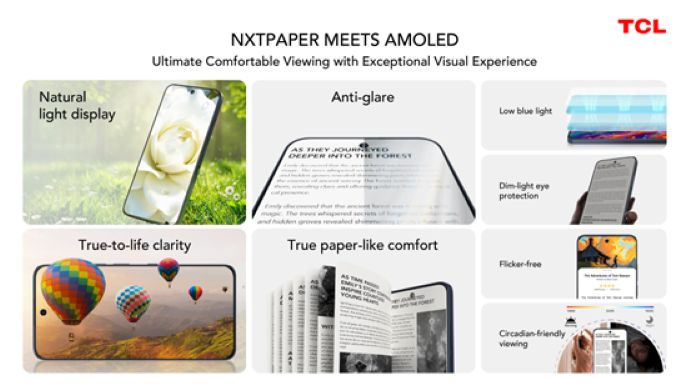
The rich, finely detailed visuals and brightness that users expect from AMOLED
-
Industry-leading eye-comfort optimizations
-
A natural-light-inspired viewing experience
-
A paper-like surface feel without sacrificing color depth
Rather than forcing users to choose between vibrancy and comfort, TCL’s latest innovation aims to offer both simultaneously.
As Jefferson Li, General Manager of TCL Mobile Phone, explained during the announcement, rising screen time has made visual fatigue a shared modern reality. Displays are now our primary gateway to communication, entertainment, and work. They must evolve not only in performance but in how they support long-term visual health.
This AMOLED + NXTPAPER fusion represents a milestone in that mission.
Visual Comfort Inspired by Natural Light
At the heart of NXTPAPER’s evolution is a deceptively simple idea: screens should feel as natural to the eyes as daylight.
Whether you’re scrolling through social media on a crowded commute, checking emails under harsh office lighting, or reading in bed at midnight, the goal is consistent, all-day comfort. TCL achieves this through multi-dimensional hardware and software optimizations designed to mimic the behavior of natural light.
Key Hardware and System Enhancements
-
Circular Polarized Light (CPL): Polarization increased from 57% to 90%, closely matching natural light behavior
-
Blue Light Purification: Harmful blue light reduced by an additional 15% versus NXTPAPER 4.0, reaching as low as 2.9%
-
Circadian Screen Comfort: Dynamic brightness and colour temperature adjustments throughout the day
-
Dim-Light Eye Protection: Brightness reduction down to 1 nit in ultra-low-light conditions
Circular Polarization at 90%
The most significant hardware breakthrough comes from an upgraded Circular Polariser Light (CPL) layer. By increasing polarisation from 57% to 90%, the display’s emitted light behaves far more like natural ambient light. This dramatically reduces visual strain compared to conventional linear polarisation systems.
Blue Light, Further Reduced
While many smartphone displays claim reduced blue light emissions, NXTPAPER pushes this further. Compared to its previous generation, harmful blue light has been cut by another 15%, lowering levels to as little as 2.9%. That’s a meaningful reduction for users who spend hours reading, watching, or gaming.
Circadian-Aware Display Behaviour
NXTPAPER doesn’t just react to brightness—it adapts to time.
The circadian screen comfort feature dynamically adjusts colour temperature and luminance to align with natural daylight cycles. Warmer tones in the evening, cooler tones during daylight hours—without harsh shifts or sudden changes.
In extremely dim environments, brightness can drop to just 1 nit. That’s exceptionally low for an AMOLED panel, helping reduce disruption to sleep cycles and minimizing eye strain during nighttime use.
The goal isn’t simply dimmer light—it’s smarter light.
Industry-First Anti-Glare on AMOLED
One of the most overlooked contributors to eye fatigue isn’t emitted light—it’s reflected light.
NXTPAPER addresses both.
For the first time in the smartphone industry, TCL is applying anti-glare (AG) technology directly to an AMOLED panel.
Using nano-matrix lithography, the display surface minimises ambient light reflections while preserving clarity and contrast. The result is a surface that behaves more like paper—diffusing glare instead of reflecting it directly back into your eyes.
This means:
-
No more angling your phone to escape window glare
-
Improved readability in bright outdoor conditions
-
Reduced visual stress when working near reflective surfaces
It’s a subtle upgrade that has outsized real-world impact.
A More Refined Paper-Like Experience
NXTPAPER has always centred around a paper-inspired viewing concept. With this latest iteration, TCL further elevates that idea.
Eye fatigue isn’t just about brightness or colour—it’s about how the surface interacts with the environment.
By optimising both emission (light coming from the screen) and reflection (light bouncing off it), the new NXTPAPER AMOLED display creates a more immersive reading experience. Whether you’re browsing long-form articles, reviewing documents outdoors, or reading before bed, the experience feels closer to physical paper—without sacrificing colour or responsiveness.
Adaptive Reading Mode
Complementing the hardware improvements is an upgraded adaptive reading mode. The system automatically adjusts background tones based on surrounding light conditions, maintaining consistent visual comfort across environments.
Under bright sunlight, it compensates for glare. Indoors, it maintains balanced contrast. At night, it shifts toward warmer, softer tones.
The aim is continuity—no jarring transitions, no manual toggling.
For users who consume long-form content on their phones, this could be one of the most meaningful upgrades in daily use.
Premium Visual Performance Without Compromise
Eye comfort means little if display quality suffers. TCL’s integration ensures that doesn’t happen.
This new NXTPAPER AMOLED panel delivers:
-
ΔE < 1 professional-grade colour accuracy
-
100% P3 wide colour gamut coverage
-
Peak brightness of 3200 nits
-
120Hz refresh rate
Colour accuracy at ΔE < 1 is typically reserved for professional-grade monitors, meaning photographers, designers, and content creators can trust what they’re seeing. The full P3 gamut ensures rich, cinematic color reproduction for streaming and gaming.
With peak brightness reaching 3200 nits, outdoor usability is no longer a concern—even under direct sunlight. And the 120Hz refresh rate guarantees fluid scrolling and smooth animations.
This isn’t an “eye-comfort display” that feels muted or dull. It’s a flagship-grade panel that happens to be easier on your eyes.
Powered by TCL’s Vertical Integration
This breakthrough is enabled by TCL’s vertically integrated display ecosystem, anchored by TCL CSOT (China Star Optoelectronics Technology).
Unlike brands that source panels externally, TCL’s deep expertise across large-format TVs, monitors, and mobile displays allows for tighter innovation cycles and deeper hardware integration.
From nano-surface treatments to polarization layers and AMOLED engineering, the company controls the stack end-to-end. That integration is what makes something as ambitious as anti-glare AMOLED with 90% circular polarization possible at scale.
A Glimpse Into the Future of Mobile Displays
The smartphone display market has traditionally moved in predictable steps: higher refresh rates, higher brightness, better colour. Incremental improvements that prioritize spectacle.
TCL’s NXTPAPER AMOLED integration suggests a different trajectory—one centered on sustainability of human use.
As screen time continues to rise globally, eye comfort is no longer a niche feature. It’s a foundational requirement. The next evolution of display technology won’t just be about how good content looks, but how good it feels to consume over hours of use.
By combining:
-
Natural-light-inspired polarization
-
Further reduced blue light emission
-
Circadian-aligned brightness and color shifts
-
Industry-first anti-glare AMOLED
-
Professional-grade visual fidelity
TCL is positioning NXTPAPER not as an alternative display mode—but as the future default.
If this technology performs in real-world devices the way it reads on paper, 2026 may mark the moment mobile displays stopped asking users to compromise between beauty and comfort.
And in an era defined by constant connectivity, that balance might be the most meaningful innovation of all.