Snapdragon Wear Elite Launches: AI-Powered Smartwatches Get a Major Upgrade

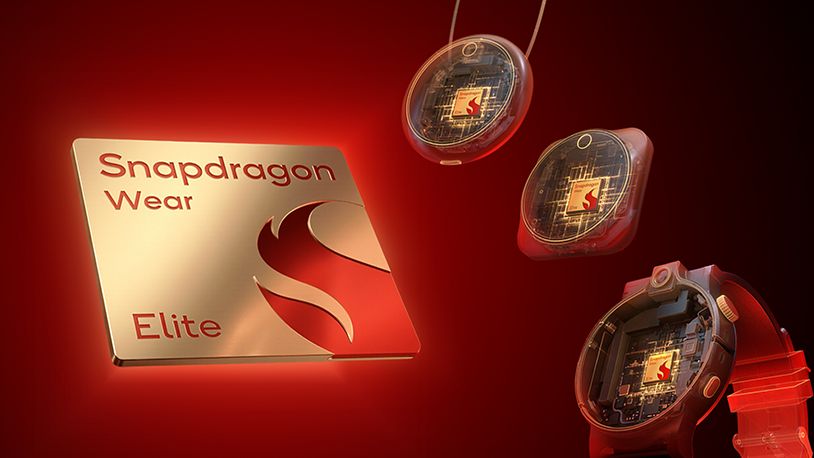
At a time when AI is rapidly moving from the cloud to the edge, Qualcomm Technologies Inc. has introduced what it calls a major leap forward for wearable computing: the Snapdragon Wear Elite Platform. Designed as a dedicated Personal AI platform, Snapdragon Wear Elite aims to power a new class of always-on, context-aware wearable devices that go far beyond basic notifications and fitness tracking.
This isn’t just another smartwatch chip refresh. Qualcomm is positioning Snapdragon Wear Elite as the foundation for an entirely new category of intelligent wearables — devices that actively participate in a distributed AI ecosystem spanning smartphones, XR headsets, PCs, and more.
Let’s break down what makes this platform significant.
A True Personal AI Platform for Wearables
Snapdragon Wear Elite is being billed as the world’s first Personal AI wearable platform built to operate across Wear OS, Android, and Linux — all while integrating a dedicated Neural Processing Unit (NPU) for on-device AI.
Unlike traditional wearables that largely act as companions to smartphones, this platform is designed to operate as an intelligent node within a broader AI network. That means:
- More AI tasks are processed directly on the device
- Reduced reliance on constant cloud connectivity
- Faster responses
- Improved privacy and contextual awareness
At the heart of this system is Qualcomm’s Qualcomm Hexagon NPU, which enables support for billion-parameter AI models running at the edge. This allows smartwatches to deliver advanced AI-driven experiences without needing to offload everything to a paired smartphone or remote server.
The “Ecosystem of You”: AI That Travels With You
Qualcomm describes its broader vision as the “Ecosystem of You” — a network of personal devices that share intelligence seamlessly, learning and adapting to a user’s habits and context.
In practical terms, Snapdragon Wear Elite enables:
- Context-aware recommendations
- Natural, conversational voice interactions
- Continuous life logging
- AI agents capable of taking actions and orchestrating tasks
Instead of simply displaying data, future wearables powered by this platform could proactively suggest actions, adjust notifications based on context, or even coordinate tasks across multiple devices.
Imagine a smartwatch that:
- Understands when you’re in a meeting and adjusts notifications accordingly
- Detects your workout environment and adapts performance metrics in real time
- Coordinates with your phone and car to prepare navigation before you leave
This is the direction Qualcomm is pushing — AI that doesn’t just respond, but anticipates.
Massive Performance Gains — Without Killing Battery Life
Performance improvements are significant on paper.
Snapdragon Wear Elite delivers:
- 5x improvement in single-core CPU performance
- Up to 7x faster GPU performance
- Smoother app launches and multitasking
- Enhanced rendering for watch faces and apps
Yet Qualcomm claims this performance leap doesn’t come at the expense of efficiency.
Battery Improvements Include:
- Multi-day battery life support
- 30% longer day-of-use compared to the previous generation
- Rapid charging to 50% in approximately 10 minutes
For wearables, power efficiency is everything. The ability to sustain always-on AI processing without dramatically reducing battery life is critical — and this is where the integrated NPU and power management architecture play a central role.
First-of-Its-Kind Multi-Mode Connectivity
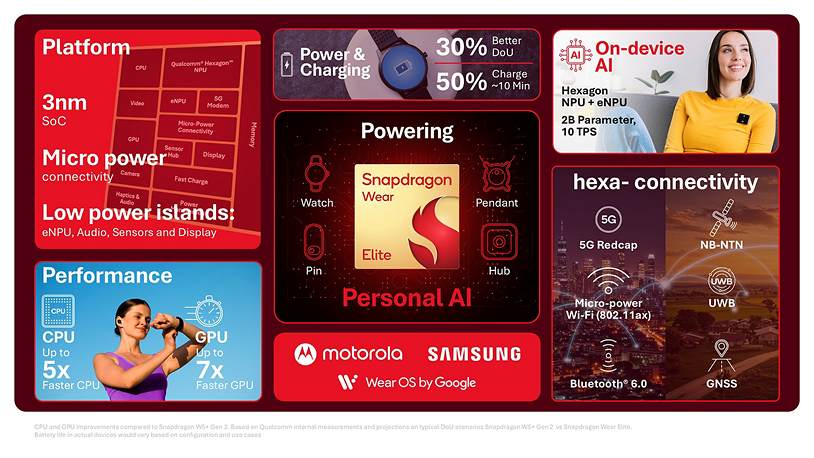
1. 5G RedCap
Designed for low-power cellular connectivity, 5G RedCap enables always-connected wearables without the energy drain of full 5G implementations.
2. Micro-Power Wi-Fi
This enables continuous AI context syncing and richer data exchange with significantly lower power consumption.
3. Bluetooth 6.0
Bluetooth 6.0 introduces proximity-aware capabilities, improving how devices locate and interact with each other within a broader personal ecosystem.
4. Ultra-Wideband (UWB)
UWB enables precise, secure proximity-based interactions — from unlocking cars to interacting with smart homes and enterprise systems.
5. Advanced GNSS
Improved location processing enhances contextual AI experiences by understanding where users are and adapting interactions accordingly.
6. NB-NTN Satellite Connectivity
Perhaps one of the most forward-looking additions, NB-NTN allows satellite-based two-way messaging when terrestrial networks are unavailable. Qualcomm is collaborating with partners including Skylo to enable this capability.
This level of connectivity integration is unprecedented in wearable platforms and sets the stage for more autonomous smartwatch functionality.
Industry Backing: Google, Motorola, Samsung
The platform is already receiving support from major ecosystem players.
According to Bjørn Kilburn, GM of Wear OS, the platform will help transform Wear OS from a traditional operating system into an intelligent, always-with-you system. The partnership between Qualcomm and Google signals a deeper integration of AI into future Wear OS devices.
Motorola
Motorola is exploring Personal AI through its “Project Maxwell” AI companion concept, first showcased at CES. Snapdragon Wear Elite will serve as the foundation to further develop these intelligent companion experiences.
The focus is clear: balanced on-device intelligence, sensing, connectivity, and efficient compute to create more intuitive daily interactions.
Samsung
Samsung Electronics is also extending its long-standing partnership with Qualcomm into the wearable space. The next-generation Galaxy Watch is expected to integrate Snapdragon Wear Elite, enhancing its wellness and AI capabilities.
This suggests we could see meaningful hardware upgrades in upcoming Galaxy Watch models powered by Qualcomm’s new platform.
What This Means for the Future of Wearables
Snapdragon Wear Elite represents a strategic shift:
- From companion device → to independent AI node
- From reactive interface → to proactive assistant
- From basic connectivity → to multi-network intelligence
As AI models become more efficient and edge computing becomes more powerful, wearables are uniquely positioned to become the most personal AI devices we own. They sit on our wrists all day, continuously collecting context — heart rate, movement, location, schedule patterns.
With an integrated NPU and advanced sensor fusion, Snapdragon Wear Elite could enable wearables that truly understand their users in real time.
When Can We Expect Devices?
Qualcomm says the first commercial devices powered by Snapdragon Wear Elite are expected to launch within the next few months. Given the public endorsements from Google, Motorola, and Samsung, we can reasonably expect major smartwatch releases leveraging this platform in the near term.
Final Thoughts
Snapdragon Wear Elite isn’t just a spec bump — it’s Qualcomm’s clearest statement yet that the future of AI is personal, distributed, and always on.
By combining:
- Dedicated on-device AI processing
- Major CPU and GPU performance improvements
- Multi-day battery support
- A first-of-its-kind six-mode connectivity stack
Qualcomm is positioning wearables as central players in the AI era.
If the company delivers on its promises, Snapdragon Wear Elite could redefine what we expect from smartwatches — shifting them from accessories to intelligent companions that truly move with us.
The next few product launches will determine whether this platform lives up to its ambitious vision, but one thing is certain: wearable computing just took a significant step forward.