
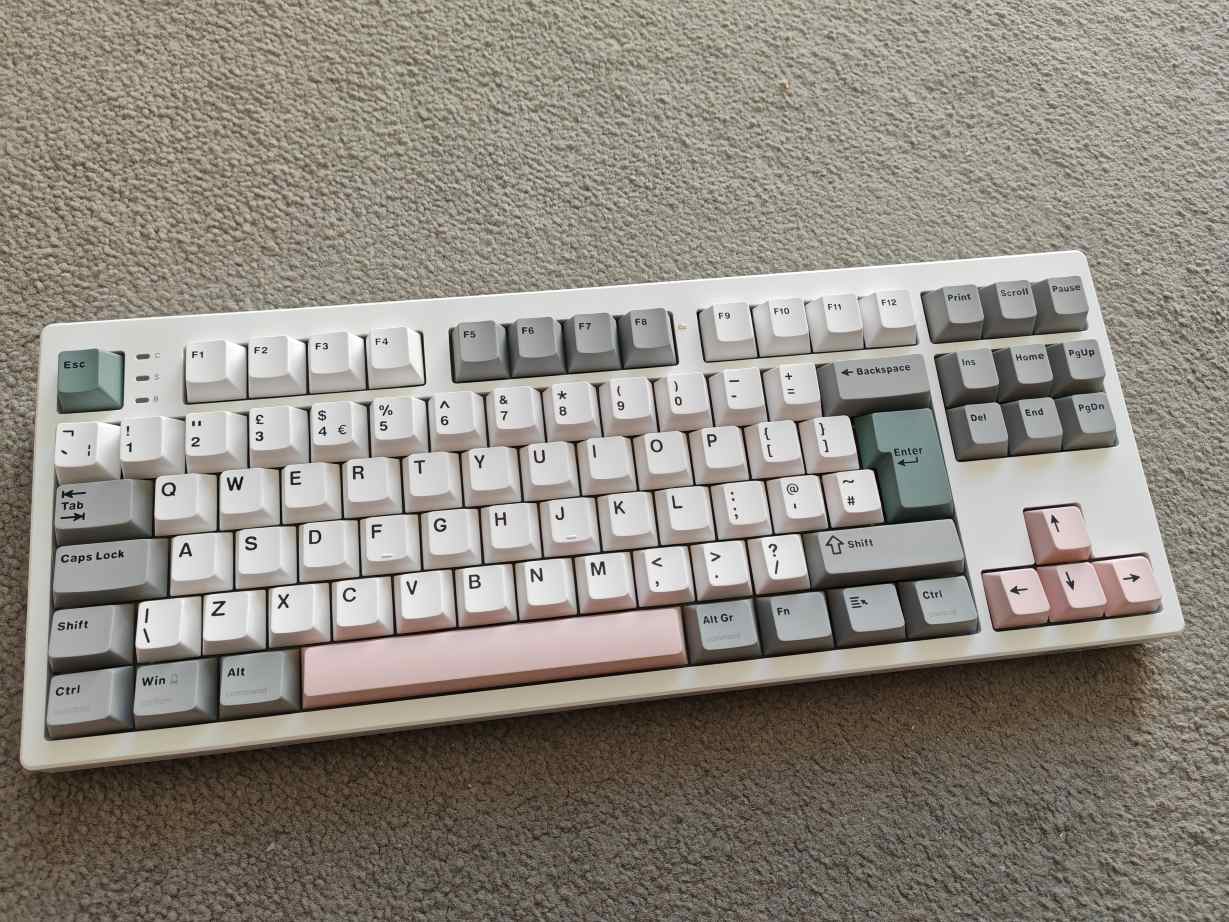
Finding a mechanical keyboard that balances modern enthusiast-grade acoustics, flex-cut gasket suspension, multi-device wireless versatility, and genuine out-of-the-box build refinement is difficult enough in the budget-to-midrange market. For typists in the United Kingdom, however, that search has historically felt almost impossible. Whilst North American ANSI users enjoy an endless stream of factory-tuned pre-builts and hot-swappable kits, European and British users are all too often relegated to afterthoughts: cut-down ISO conversions, poorly mapped secondary legends, compromised return keys, or exorbitant import fees for barebones kits that still require hours of switch lubing and stabiliser tuning. Welcome to the Epomaker TH87, available from the Epomaker website and Amazon UK for under £72.00.
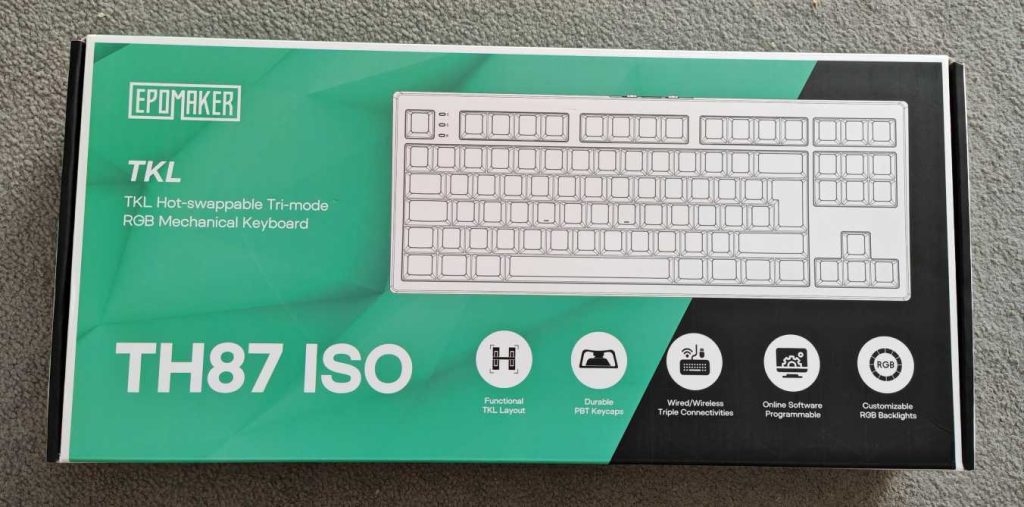
The Epomaker TH87 ISO-UK is designed specifically to dismantle that dynamic. Preserving the classic 80% tenkeyless (TKL) footprint with an authentic 87-key layout, the TH87 pairs a true double-height ISO Enter key, proper UK-specific punctuation, and factory-lubed switches with a jaw-dropping 10,000mAh internal battery and a zero-install, web-based driver ecosystem. After subjecting the board to three weeks of extensive daily editorial writing, late-night software development, competitive gaming sessions, and acoustic lab analysis, we take an exhaustive look at whether this sub-£100 keyboard sets a new standard for the UK market.
Technical Specifications & Hardware Architecture
| Category | Specification Details |
| Model | Epomaker TH87 ISO-UK |
| Form Factor | 80% Tenkeyless (TKL) / 87-Key British Layout |
| Mounting Architecture | Gasket-mounted structure with silicone perimeter tabs |
| Plate Material | Multi-slot flex-cut Polycarbonate (PC) |
| Internal Acoustic Stack | 5-Layer Sound Optimising Design (Poron plate foam, IXPE switch pad, PET sound-enhancing film, EPDM switch socket pad, silicone moulded bottom pad) |
| Switch Options | Epomaker Creamy Jade (Linear) or Epomaker Sea Salt Silent V2 (Linear Silent); factory pre-lubricated |
| Hot-Swap Compatibility | 3-Pin and 5-Pin universal Kailh/TTC-style hot-swap sockets |
| Backlighting & Illumination | South-facing per-key 16.8M RGB LEDs + Dual lateral side light strips |
| Keycap Profile & Material | Cherry Profile, thick dye-sublimated PBT |
| Connectivity | Tri-mode: 2.4GHz wireless, Bluetooth 5.0 (3 device channels), USB-C wired |
| Polling Rate & Latency | 1000Hz / 2ms (Wired), 1000Hz / 5ms (2.4GHz), 125Hz / 11ms (Bluetooth) |
| Battery System | 10,000 mAh rechargeable Lithium-ion cell |
| Battery Endurance | Up to 200 hours (RGB off) / ~45–60 hours (RGB on continuously) |
| Configuration Interface | Epomaker Hub (WebHID in Google Chrome / Microsoft Edge) |
| Chassis Material | Structural ABS engineering thermoplastic |
| Dimensions & Weight | 366.5 mm x 142.1 mm x 41.4 mm; 1,020 g |
| Incline Angles | Three-stage adjustment: 6°, 8°, and 10.5° |
| Platform Compatibility | Windows, macOS |
Unboxing Experience and Packaging Contents
Epomaker ships the TH87 in a reinforced, matte-finished retail box adorned with minimalist line art depicting the TKL layout. Inside, the packaging layout reflects a welcome level of protection. Rather than resting bare inside a flimsy anti-static bag, the keyboard sits ensconced between two thick blocks of closed-cell polyethene foam, capped with a form-fitting, transparent rigid plastic dust cover. For desktop users who frequently leave their workspaces unattended overnight or who share home offices with pets, this dust cover is a practical accessory that extends the cleaning intervals of your switches and plate.
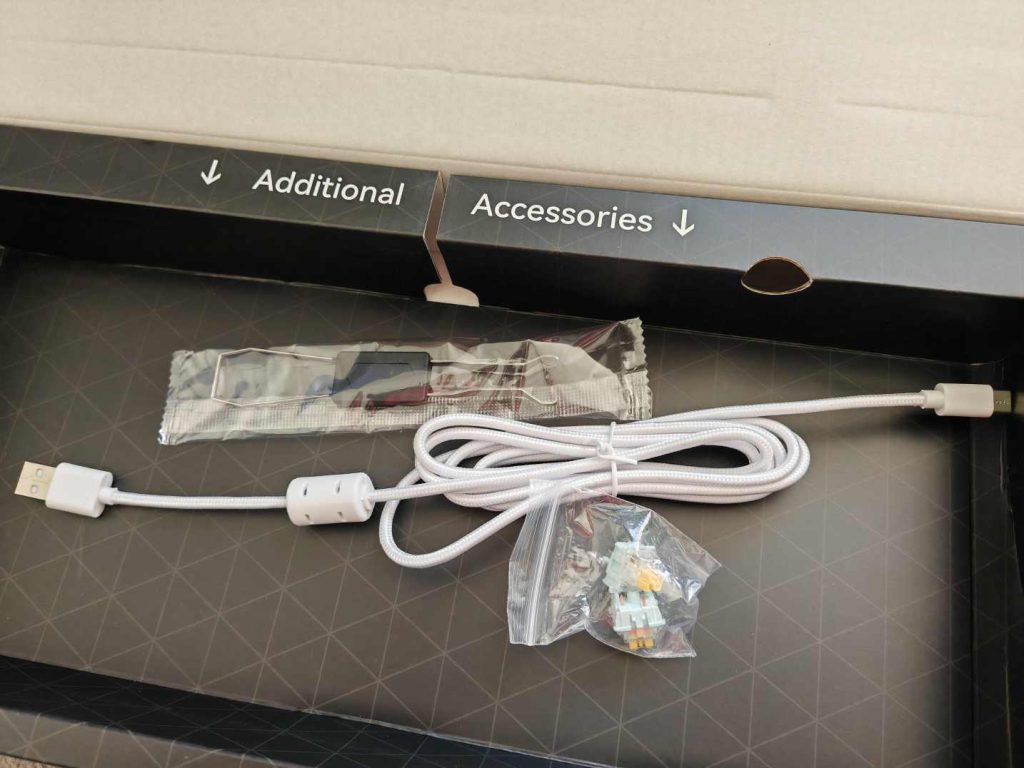
Beneath the keyboard compartment lies a dedicated cardboard partition containing the bundled hardware accessories:
-
Braided USB-C to USB-A Cable: A 1.8-metre, tightly woven fabric cable in off-white/light grey matching the keyboard casing. It features moulded strain reliefs and an integrated ferrite choke to suppress electromagnetic interference during high-speed wired data transmission.
-
Dual-Function Puller Tool: A metal wire keycap puller on one end and a stamped steel switch-pulling clip on the reverse. Unlike destructive ring-style plastic keycap pullers that scratch the outer walls of PBT caps, this wire puller slides effortlessly around Cherry-profile keycaps without marring their edges.
-
Spare Replacement Keycaps: Two extra theme-matching accent/spare keycaps rather than platform-specific modifiers, handy for cosmetic customisation or swapping out high-wear keys without altering the stock ISO legend layout.
-
Instructional Documentation: A multi-language accordion guide outlining onboard FN key shortcuts, hardware reset sequences, battery diagnostics, and wireless pairing protocols.
Chassis Design, Materials, and Workspace Aesthetics
The modern mechanical keyboard enthusiast sphere has spent several years in an arms race towards all-aluminium, five-pound desk anchors. Whilst dense aluminium certainly delivers an undeniably luxurious tactile coldness, it brings compromises that often go unmentioned in short reviews: poor wireless RF transmission, high carrying weight, sharp chassis edge transitions, and an uncomfortably pingy acoustic resonance if the interior is not packed with dense lead-sheet or silicone dampening.
With the TH87, Epomaker opted for a high-density, structural ABS engineering thermoplastic enclosure. Far from feeling hollow or brittle, the casing exhibits reassuring rigidity. During aggressive torsion tests—gripping the outer edges and twisting with substantial physical force—the frame exhibits zero creaking, zero seam separation, and no detectable deck flex. The top and bottom shell halves snap together via internal interlocking tabs secured by recessed perimeter screws, resulting in clean, uniform panel gaps throughout the perimeter.
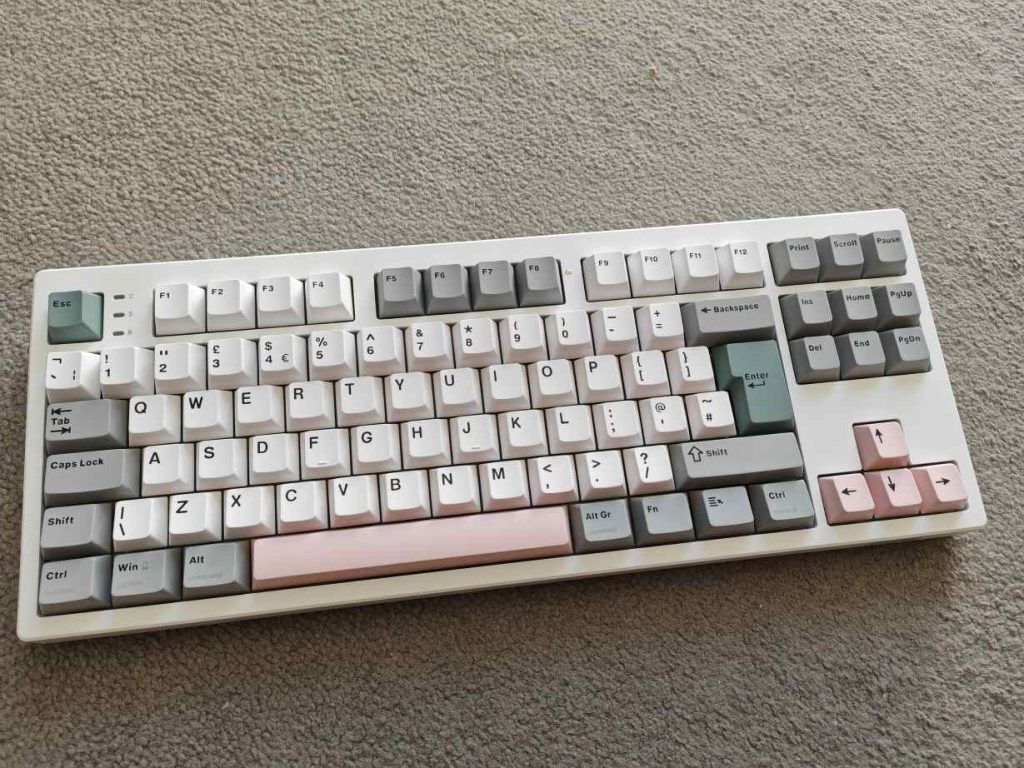
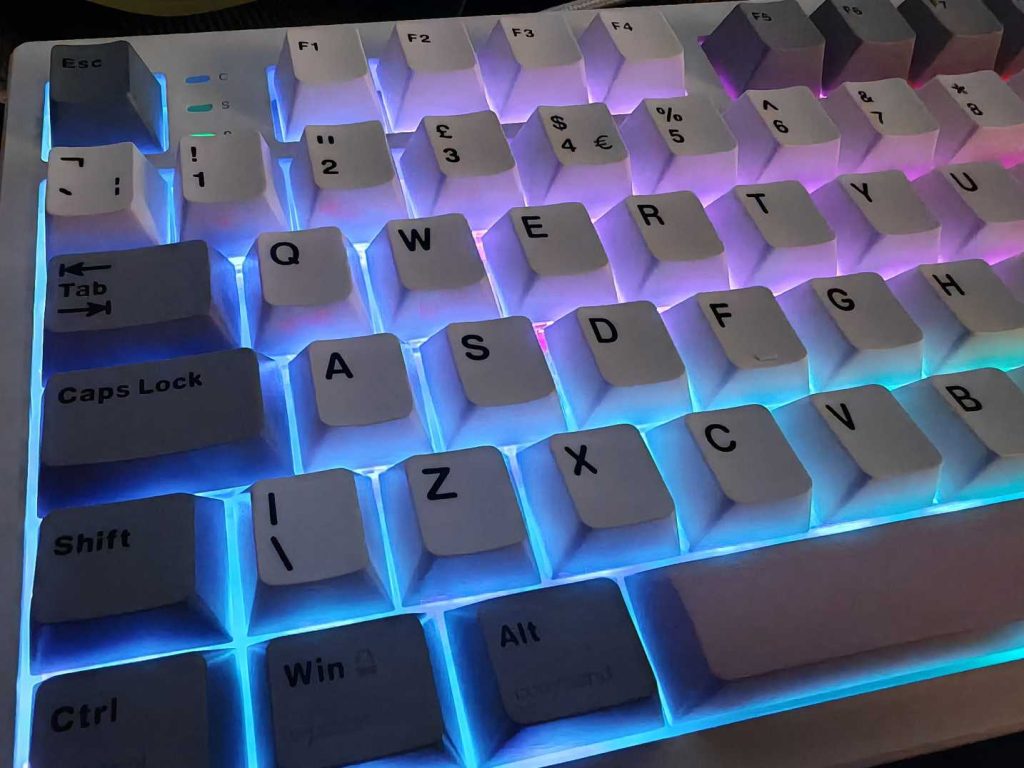
Visually, the keyboard adopts a calm, retro-futuristic aesthetic. The base shell is finished in a warm, light-slate grey with subtly rounded corner radii that keep it from looking aggressively angular. The keycap arrangement complements this base with an off-white alphanumeric alphas cluster, soft stone-grey modifiers, and muted teal/sage accents on the Return key, Spacebar, and Escape key. The styling allows the TH87 to look right at home in a corporate boardroom or a curated, minimalist studio suite without screaming “RGB gaming peripheral” across the desk.
Lateral Diffusion Strips
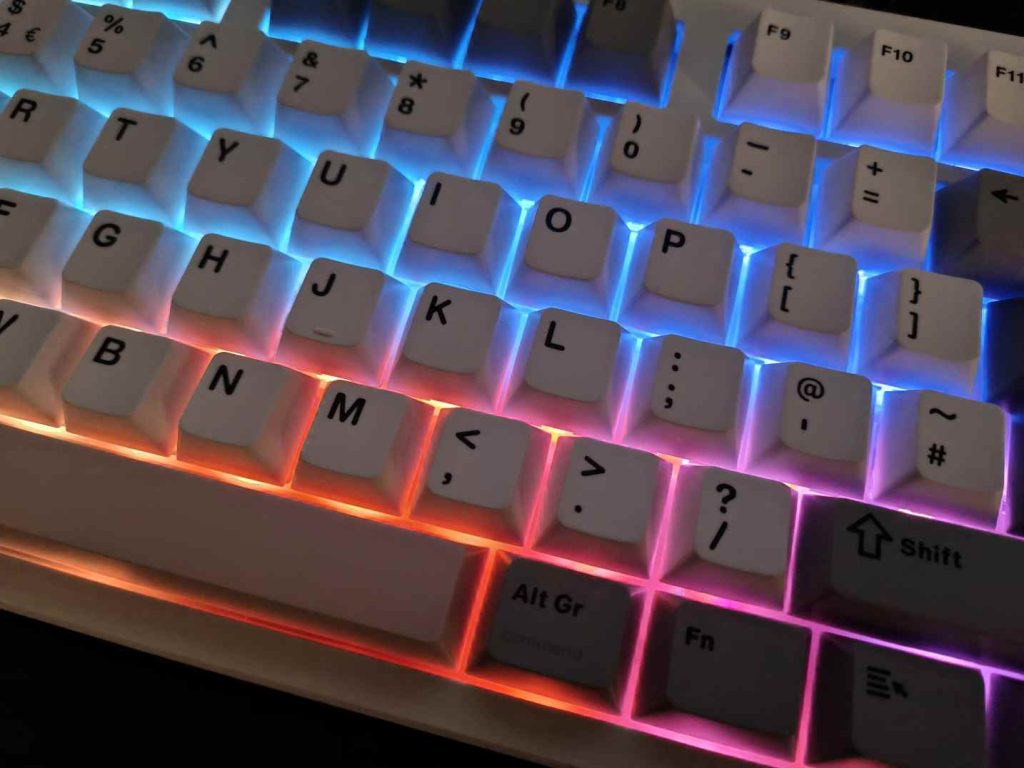
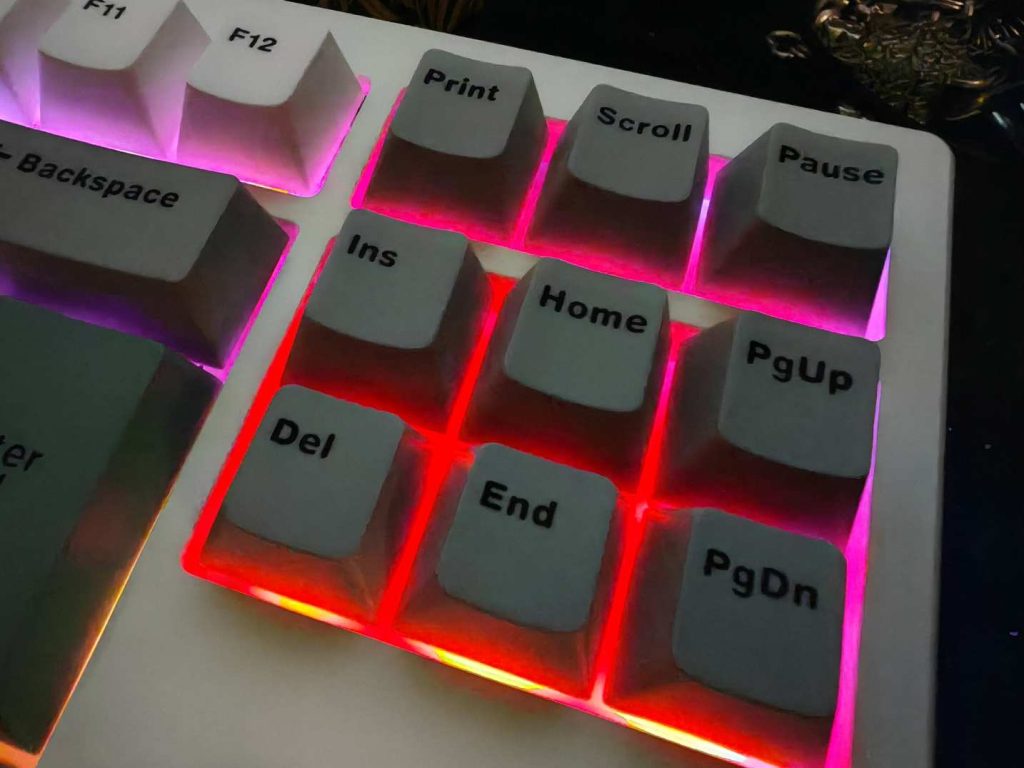
Rather than relying solely on switch backlighting for visual flair, Epomaker integrated two longitudinal frosted acrylic light channels running along the lower flanks of the case. These lateral light strips draw power from internal surface-mount LEDs, casting a smooth, diffused ambient glow directly down onto your desk mat or wooden surface. Because the light is bounced indirectly against the desk rather than projected straight into the typist’s field of view, it acts as an eye-strain-reducing accent that creates a soft halo around the keyboard footprint.
Ergonomics and Underbody Engineering
The front chin height of the TH87 sits at exactly 18.5mm, tapering up to an unadjusted rear typing angle of 6 degrees. For most typists practising floating-wrist ergonomics, this low front profile minimises wrist extension, allowing comfortable long-form typing even without a supplementary wooden or leather wrist rest.
Flipping the keyboard over reveals thoughtful base detailing:
-
Four broad, textured non-marking silicone pads provide exceptional friction against wood, glass, and fabric deskmats.
-
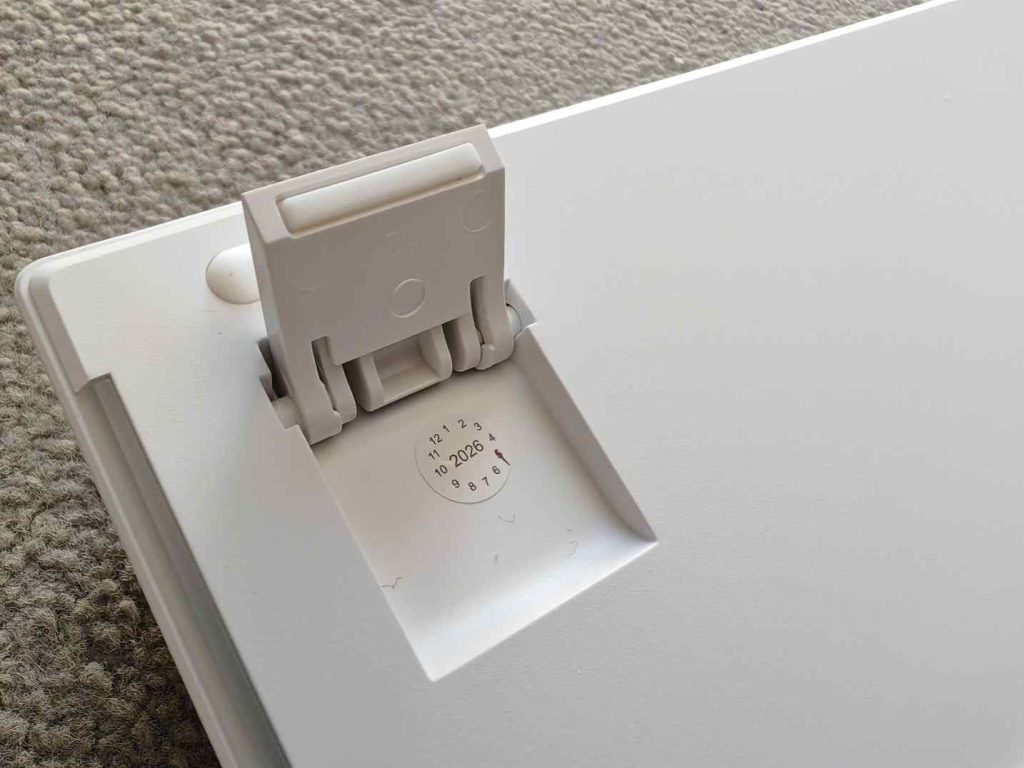
A pair of dual-stage folding kickstand feet allow users to elevate the incline.
-
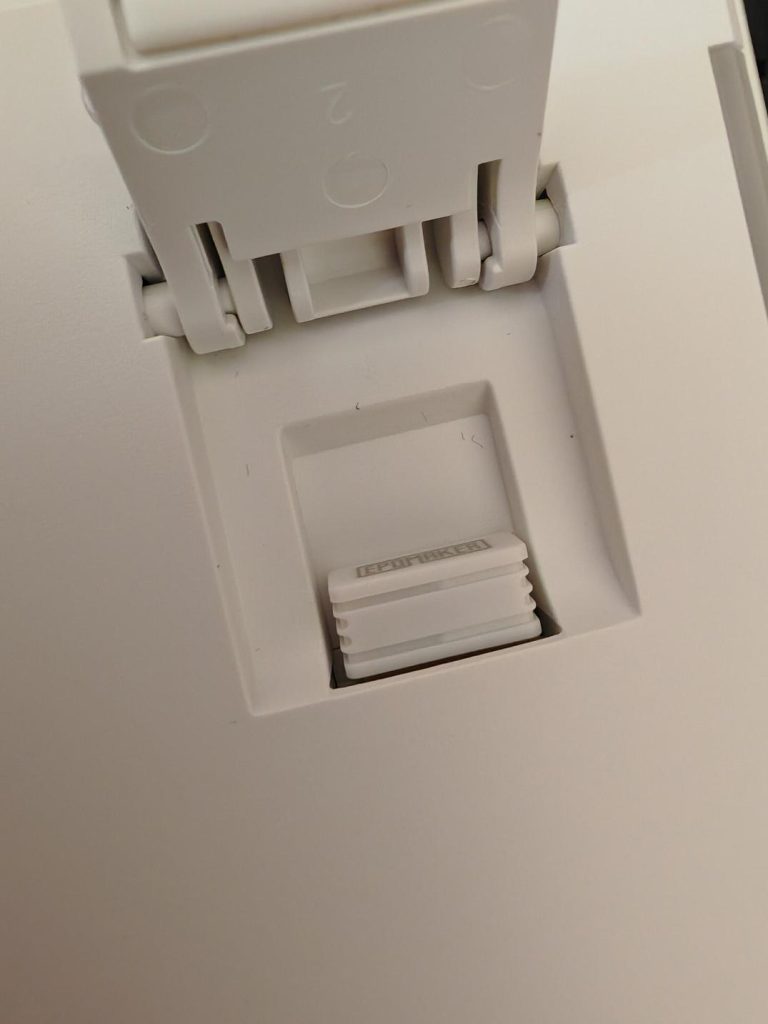
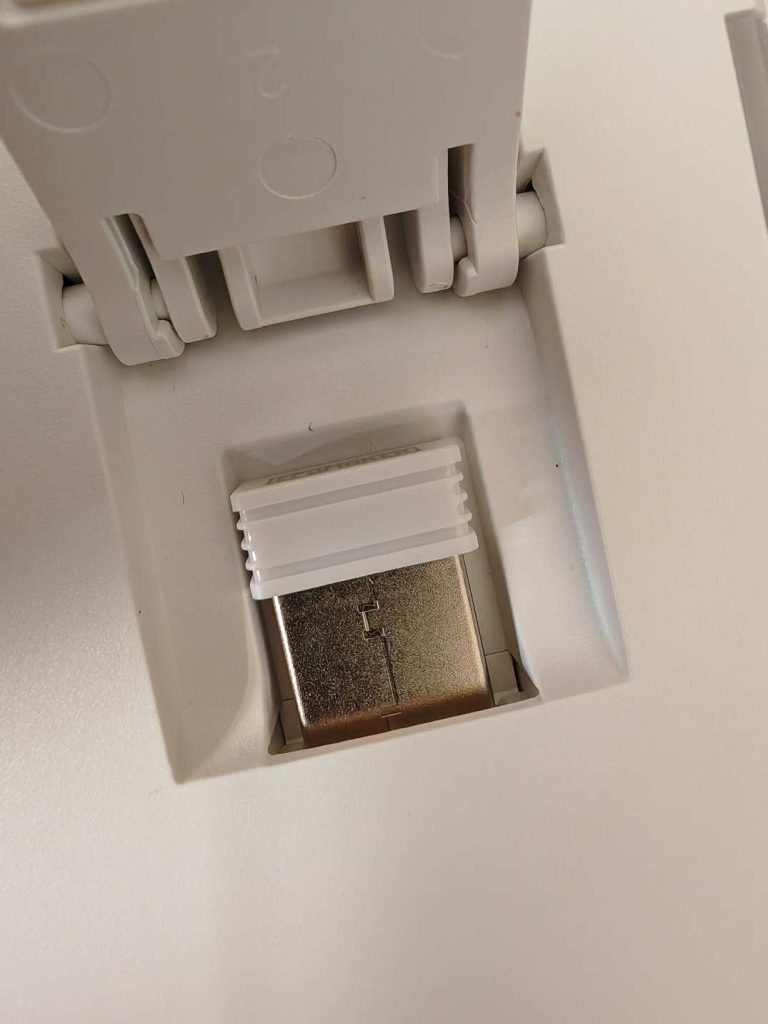
A dedicated magnetic recess houses the compact 2.4GHz USB Type-A receiver. The magnet possesses sufficient pull force that shaking the board vigorously will not dislodge the dongle whilst on the move.
-
A smooth, positive-action physical slide switch allows immediate switching between 2.4GHz wireless, USB-C wired mode (which also powers the board off for transit), and Bluetooth mode.
The Native ISO-UK Layout: Ergonomic & Typographic Breakdown
For British writers, coders, accountants, and administrative professionals, typing on an American ANSI layout keyboard remains a persistent source of frustration. Muscle memory developed over decades of typing on standard UK hardware makes the small horizontal ANSI Return key, missing backslash placement, and swapped secondary symbols constant sources of typing errors.
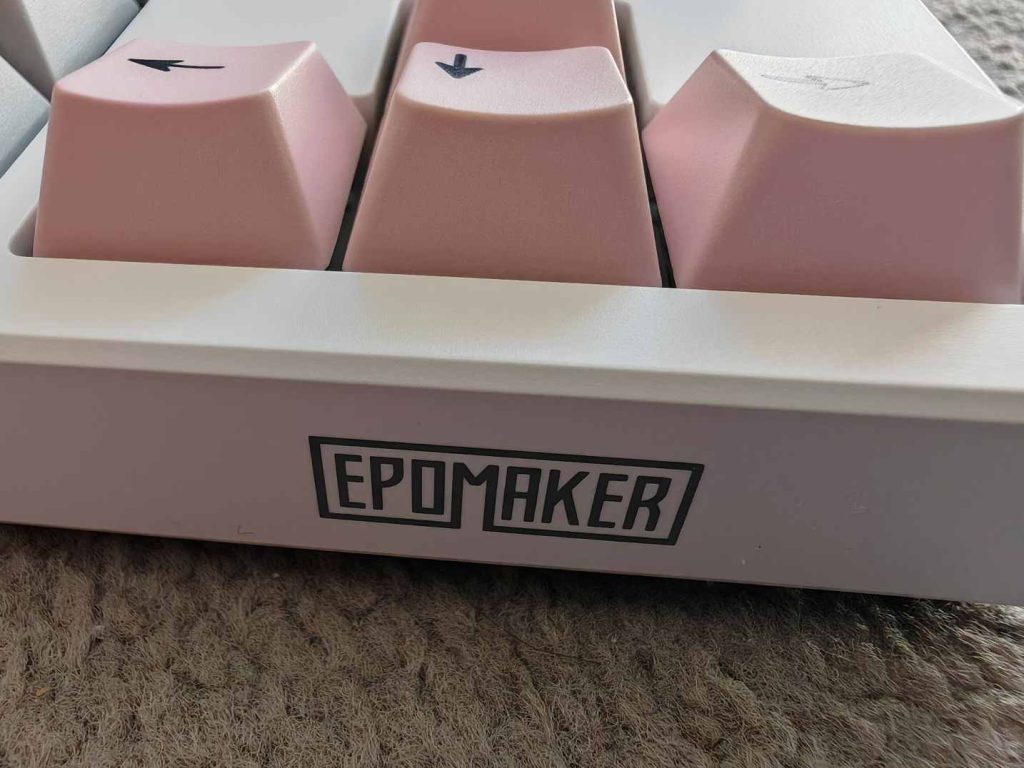
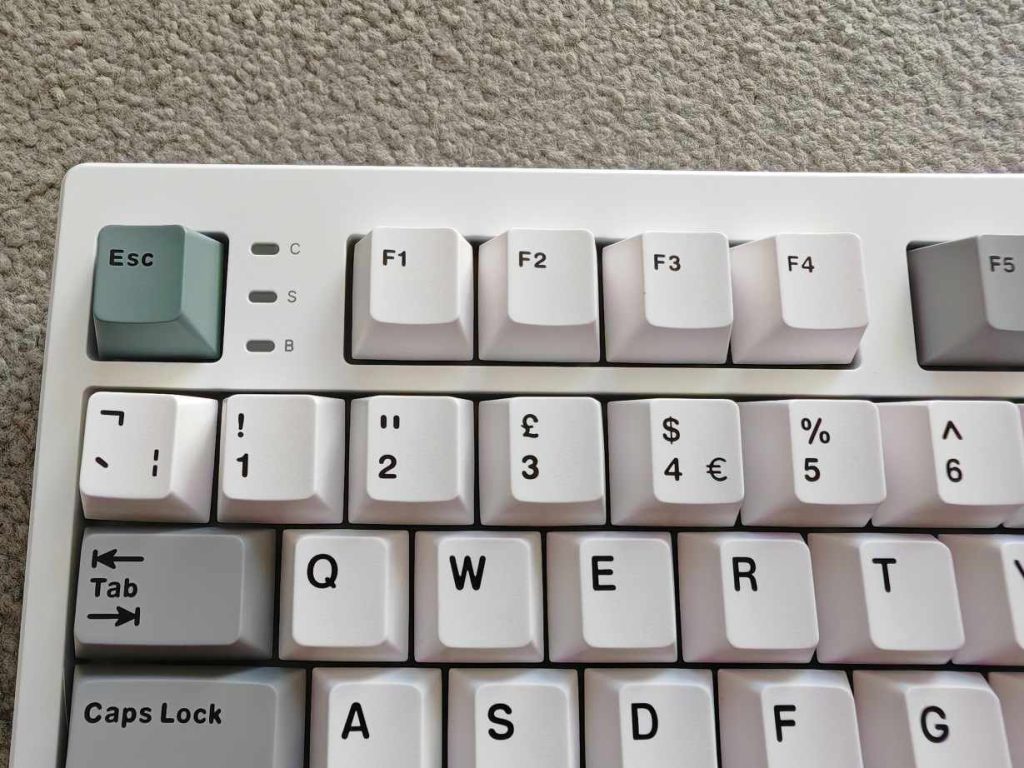
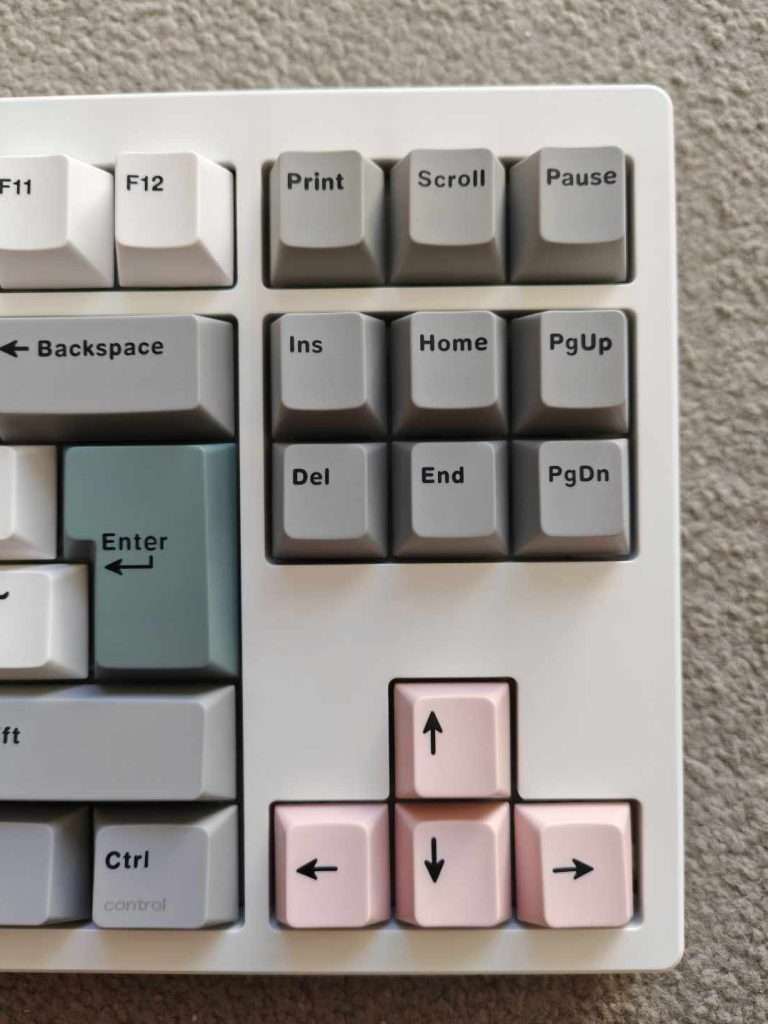
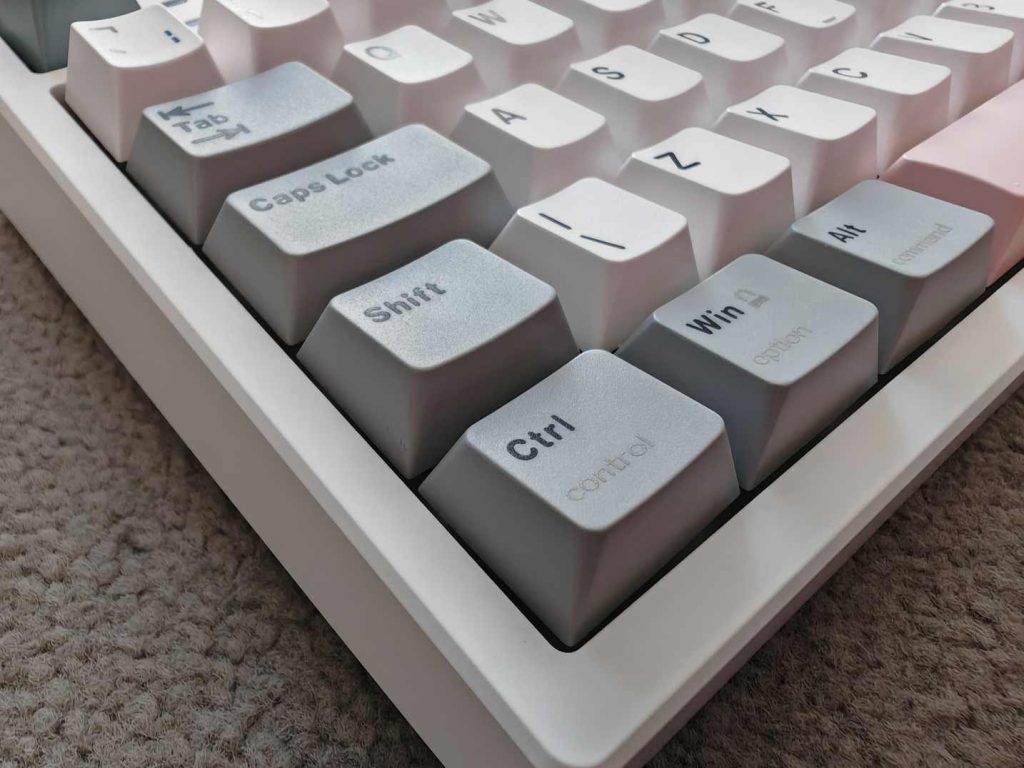
The TH87 is built from the ground up on the authentic 87-Key ISO-UK layout, with every key, stabiliser, and legend tailored to British computing standards:

-
The Double-Height ISO Return Key: The tall, hook-shaped Enter key provides a massive target for the right pinky, offering the unmistakable, satisfying tactile feedback that UK typists expect when concluding a paragraph or executing terminal code.
-
Left Shift & Backslash Cluster: ANSI keyboards feature an elongated left Shift that shifts the entire lower alpha row offset. The TH87 preserves the true short ISO Left Shift accompanied by the dedicated
\(backslash) and|(pipe) key placed immediately between Shift andZ—a crucial arrangement for developers writing regex, directory paths, or shell scripts. -
Dedicated Currency and Punctuation Mapping: The
3key features the native£symbol alongside the#hash key positioned above the right Shift; the2key properly maps the"quotation mark; the@symbol sits comfortably adjacent to the apostrophe key on the home row; and the~tilde is readily accessible without convoluted three-key secondary layering.
The keycaps are moulded from thick, high-density PBT (Polybutylene Terephthalate) in the classic Cherry profile. Unlike OEM profile keycaps, which stand noticeably taller and can induce finger strain over time, Cherry profile features an ergonomic, sculpted cylindrical sweep that contours naturally to finger arcs. The dye-sublimation printing is crisp, sharp, and deeply saturated. Because the dye penetrates deep into the plastic polymer rather than resting on the surface like cheap pad-printed or laser-etched ABS keys, these legends will resist fading, yellowing, or developing greasy friction shine across millions of keystrokes.
Internal Architecture: Gasket Suspension and the 5-Layer Acoustic Stack
What truly separates the Epomaker TH87 from generic office mechanical keyboards is its internal structural engineering. In traditional tray-mount designs, the circuit board and switch plate are screwed directly to rigid standoffs moulded into the bottom housing. This rigid metal-to-plastic contact creates hard structural vibration reflection points, resulting in an uneven, jarring typing feel where keys closer to mounting screws feel stiff and loud whilst keys in the centre feel loose.
The TH87 employs a true gasket-mounted suspension system. The entire internal sandwich—consisting of the switch plate, acoustic dampening foams, PCB, and bottom barrier—rests freely suspended on custom-moulded silicone gaskets positioned around the inner perimeter of the ABS chassis. No screws puncture the typing plane. When you strike a key, the silicone tabs compress softly, providing noticeable mechanical give and dissipating impact energy horizontally across the perimeter.
To complement this suspension, Epomaker equipped the board with a precision-milled Polycarbonate (PC) plate featuring horizontal flex cuts between key rows. Polycarbonate possesses a much lower modulus of elasticity than rigid brass, steel, or aluminium, imparting a distinctly soft, springy bounce to every downward stroke.
The 5-Layer Acoustic Tuning Architecture
Beneath the switches lies an intricate acoustic labyrinth engineered to filter out unwanted high-frequency metallic ping whilst amplifying low-frequency, resonant vibrations:
-
Poron Sandwich Foam (Top Layer): Positioned directly between the PC switch plate and the PCB surface, this micro-cellular polyurethane foam absorbs the initial acoustic pressure waves generated when the switch stem impacts the plate.
-
IXPE Switch Pad (Second Layer): A high-density, cross-linked polyethene film resting directly beneath the switch housings. IXPE acts as an acoustic diffuser, focusing the physical bottom-out frequency of the switch stem into a distinct, clean, rounded sound signature.
-
PET Sound-Enhancing Film (Third Layer): A thin, crystal-clear polyester film positioned between the IXPE foam and the circuit board. This layer functions almost like a miniature drumhead, reflecting acoustic energy upward to produce the sought-after “poppy” sound profile that custom keyboard builders spend hours modding boards to achieve.
-
EPDM Switch Socket Foam (Fourth Layer): Laminated to the rear of the PCB, this ethylene propylene diene monomer layer encapsulates the Kailh/TTC hot-swap sockets, eliminating metallic pinging vibrations generated by switch pins engaging with internal socket leaf springs.
-
Pre-Moulded Silicone Base Cavity Pad (Bottom Layer): The floor of the ABS housing is filled with a hefty, custom-poured solid silicone insert. By eliminating all hollow interior airspace between the PCB and the lower chassis shell, this heavy base pad prevents the case from acting as an echo chamber, anchoring the keyboard acoustically and physically to your desk surface.
Switches, Actuation Dynamics, and Stabiliser Tuning
The Epomaker TH87 is offered from the factory with two distinct switch options, catering to polar-opposite acoustic and tactile preferences: the Epomaker Creamy Jade linear switch and the Epomaker Sea Salt Silent V2 linear switch.
Option 1: Epomaker Creamy Jade (The Acoustic Enthusiast’s Choice)
-
Switch Architecture: 5-Pin Linear Mechanical Switch
-
Stem: Self-lubricating POM (Polyoxymethylene) with dust-proof wall design
-
Housing: Proprietary nylon blend top and bottom housing
-
Actuation Force: 45 ± 5 gf
-
Bottom-Out Force: 53 ± 5 gf
-
Pre-Travel: 2.0 ± 0.4 mm
-
Total Key Travel: 3.6 ± 0.2 mm
The Creamy Jade switch is engineered for typists who enjoy crisp acoustic feedback and buttery-smooth downward travel. The slightly shortened 3.6mm total travel (compared to standard 4.0mm travel switches) provides an immediate, snappy bottom-out that benefits fast touch-typing and rapid multi-tap gaming inputs. Because the POM stem glides against factory-lubricated nylon housing rails, there is no detectable micro-scratchiness or binding when keys are pressed off-centre.
Acoustically, the combination of Creamy Jade switches, the PC flex-cut plate, and the PET film creates a sound profile best described as deep, marbly, and moderately thocky. It delivers an authoritative acoustic pop that remains pleasant to the ear without crossing into the harsh, piercing clatter associated with unlubed clicky switches or stiff metal-plate keyboards.
Option 2: Epomaker Sea Salt Silent V2 (The Office & Library Specialist)
-
Switch Architecture: 5-Pin Silent Linear Switch
-
Stem: Modified POM with dual-integrated internal elastomer silencing pads
-
Actuation Force: 40 ± 5 gf
-
Bottom-Out Force: 50 ± 5 gf
-
Total Key Travel: 3.8 mm
Stabiliser Performance and Factory Lubrication
Nothing ruins an otherwise great mechanical keyboard faster than rattly, poorly lubricated stabilisers on the larger modifier keys. The TH87 uses plate-mounted stabilisers with reinforced POM housings and stainless-steel wire bars.
Inspecting the stabilisers under studio magnification reveals that Epomaker applies a generous, uniform coating of high-viscosity synthetic grease (comparable to Krytox GPL 205g0 / XHT-BDZ) directly into the stabiliser stem channels and around the wire bend points. Testing the oversized ISO Enter key, the 6.25u Spacebar, Left Shift, and Backspace demonstrated zero wire ticking, zero asymmetric tilt, and zero hollow rattle. The spacebar in particular drops down with a dense, solid acoustic thud that matches the tonal pitch of the alphanumeric keys perfectly.
Tri-Mode Connectivity, Wireless Stability, and Gaming Latency
Modern productivity setups demand flexibility. Many users split their working hours between a stationary desktop PC, a work-issued laptop, and mobile devices like an iPad or Android tablet. The TH87 addresses this via a robust tri-mode wireless architecture:
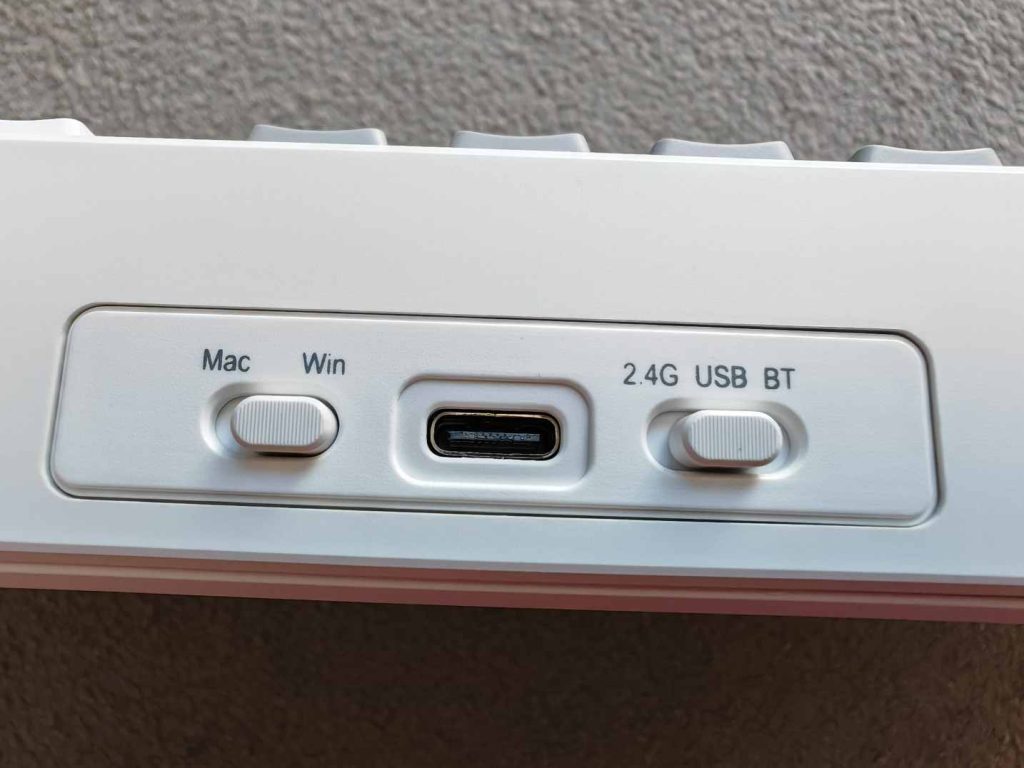
1. 2.4GHz Wireless Protocol (The Zero-Latency Workhorse)
For desk setups free from cable clutter, the included 2.4GHz nano-dongle connects directly to any USB-A port. Utilising a proprietary low-latency RF protocol running at a true 1000Hz polling rate, the keyboard processes keystrokes in approximately 5 milliseconds.
In daily office testing, keystrokes register instantaneously without sluggish wake-up latency after idle periods. In gaming benchmarks across competitive titles like Counter-Strike 2, Valorant, and Overwatch 2, we observed zero dropped inputs, missed strafe cancels, or signal stuttering, even with an active Wi-Fi 6 router transmitting less than two feet away. The RF link remained unbroken across line-of-sight distances exceeding 8 metres.
2. Bluetooth 5.0 Multi-Device Paging
For mobile devices, laptops, and smart TVs, the TH87 integrates a high-efficiency Bluetooth 5.0 module supporting three discrete pairing profiles. Pressing Fn + 1, Fn + 2, or Fn + 3 initiates swift pairing or toggles between active devices. Switching between an Apple MacBook Air and a Windows desktop machine takes roughly 1.5 seconds from keypress to active input state. Polling rate in Bluetooth mode is capped at 125Hz (11ms latency)—a hardware standard across Bluetooth HID protocols—which is well suited for document editing, email triage, and spreadsheet management, whilst conserving maximum battery power.
3. USB-C Wired Mode
Flipping the rear hardware toggle to the centre position engages wired mode over the included braided cable. In wired mode, the microcontroller locks into an uncompressed 1000Hz polling rate with sub-2ms hardware input latency. The keyboard provides complete N-Key Rollover (NKRO) and 100% anti-ghosting. Every single keypress registers accurately, even when mashing down a dozen simultaneous keys across gaming chords or digital audio workstation shortcuts.
The 10,000mAh Battery System: Real-World Longevity
Battery life is an area where the Epomaker TH87 comfortably leaves the rest of the mechanical keyboard industry behind.
The vast majority of wireless mechanical keyboards on the market pack modest batteries ranging between 3,000mAh and 4,000mAh. When driving bright per-key RGB LEDs and high-polling wireless radios, those smaller batteries run dry in just 3 to 5 days, turning “wireless” peripherals into wired hardware anchored to a charging cable half the time.
Epomaker bypassed this limitation by building a massive 10,000mAh dual-cell lithium-ion battery system into the lower cavity of the TH87. This is comparable to the capacity of a standalone portable power bank, and the real-world endurance figures reflect that scale:
-
Scenario A: Office Productivity / RGB Off (2.4GHz Mode): With backlighting disabled, the TH87 operates for up to 200 hours of continuous active typing. Under a standard 8-hour workday routine (40 hours per week), you can comfortably use this keyboard for four to five consecutive weeks before ever needing to plug it into a charger. During our own testing period spanning three weeks of daily use, the battery gauge barely dipped below 60%.
-
Scenario B: RGB Backlighting at 100% Brightness (Dynamic Rainbow Wave): With every switch LED and both lateral side strips blazing at maximum intensity, power draw increases dramatically. Even under this torture test, the 10,000mAh cell delivered 45 hours of continuous runtime—far surpassing competing boards that often die after just 10 to 14 hours with full RGB active.
-
Scenario C: Mixed Daytime/Evening Use (50% Ambient Backlighting): In typical usage—dim lighting in the evening and sleep timeouts enabled during breaks—users can expect between 80 and 100 hours of operational battery life.
Power Management and Quick Diagnostics
To safeguard the battery, the TH87 employs a multi-tier intelligent sleep protocol:
-
Light Sleep (5 Minutes Inactivity): Backlighting and side strips dim down to conserve power. Tapping any key instantly wakes the illumination without dropping keystrokes.
-
Deep Hibernation (30 Minutes Inactivity): The internal wireless radio powers down into ultra-low-current sleep. Pressing any key wakes the device in less than 200 milliseconds.
Checking remaining battery capacity is straightforward even without opening software: pressing Fn + Enter illuminates the numeric row keys (1 through 0) in bright green. If numbers 1 through 8 light up, the board has approximately 80% charge remaining. When the battery drops below 15%, the spacebar LED flashes a warning red pulse, giving you plenty of lead time to plug in the braided USB-C cable. Recharging from empty to full takes approximately 6 hours over a standard 5V/2A charging connection.
Online Setup & Configuration: The Epomaker Hub Web Driver
One of the most notable quality-of-life enhancements introduced with modern Epomaker peripherals is the transition away from bloated desktop driver software in favour of Epomaker Hub.hub.epomaker.com).
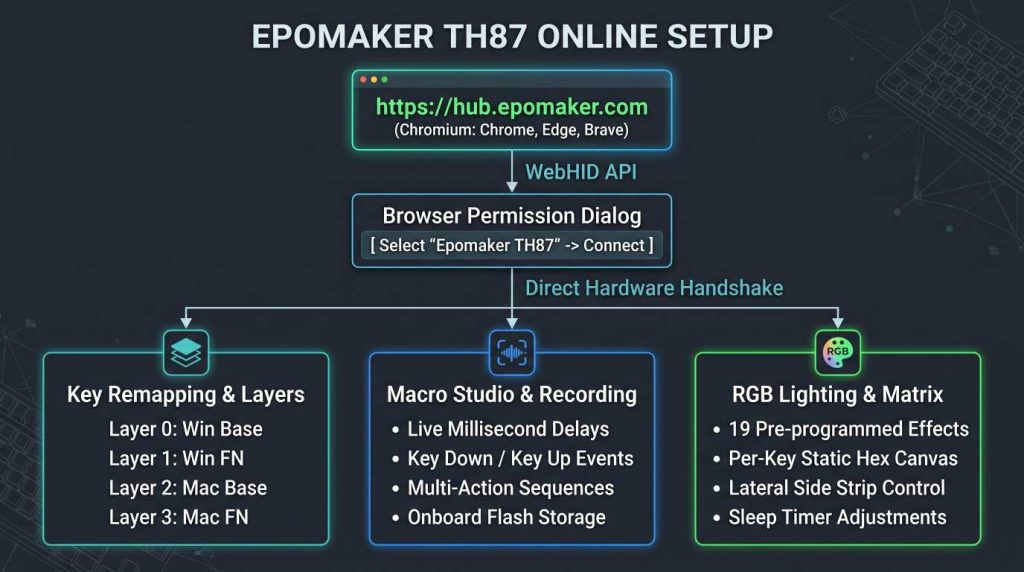
Traditionally, owning a budget-to-midrange mechanical keyboard meant hunting down obscure .zip archives from overseas hosting servers, installing unverified .exe files that trigger Windows Defender warnings, and leaving persistent background telemetry processes running in your system tray just to remap a single key. The Epomaker Hub replaces that entire friction-laden process with a lightweight, browser-based WebHID portal.
Step-by-Step Connection Walkthrough
-
Browser Compatibility: Launch a modern Chromium-based web browser on your desktop computer. Google Chrome, Microsoft Edge, Brave, and Opera all feature native support for the WebHID (Human Interface Device) API. Note that Safari and Mozilla Firefox do not support direct WebHID device communication and cannot be used for hardware configuration.
-
Physical Connection Requirement: Flip the hardware toggle switch on the back of the TH87 to Wired Mode (centre position) and connect the keyboard to your computer via the bundled USB-C cable. Whilst wireless battery status telemetry can be viewed wirelessly in recent firmware builds, writing new macro memory maps, flashing firmware, or modifying key matrix layers requires a stable wired connection to eliminate any risk of packet interruption during flash operations.
-
Accessing the Portal: Navigate to
hub.epomaker.comin your browser. -
Authorising Hardware Access: Click the primary “Bind Device” or “Connect” button on the landing dashboard. A native browser security modal will drop down from the address bar displaying a list of detected USB devices. Highlight “Epomaker TH87” and click Connect.
-
Layout Synchronisation: The web utility immediately queries the keyboard’s onboard EEPROM microcontroller, instantly loading a high-resolution, interactive graphical interface showing the exact 87-key ISO-UK cluster, including the vertical Return key and split Left Shift.
Exploring the Hub’s Functional Modules
-
Key Remapping and Layer Management: The utility exposes four distinct programmable layers: Layer 0 (Windows Base), Layer 1 (Windows FN), Layer 2 (Mac Base), and Layer 3 (Mac FN). To remap a key, simply click on the virtual key on screen, then choose a replacement function from the lower palette. The system supports full alphanumeric replacement, media controls (Volume Up/Down, Mute, Play/Pause, Track Skip), mouse actions (Left/Right click, Scroll), and system commands (Lock Screen, Calculator, File Explorer, Web Browser).
-
Macro Studio Engine: For programmers, accountants, and gamers who rely on repetitive key sequences, the integrated Macro Studio records keystrokes with live millisecond timing. Users can capture intricate combo strings, manually insert delays, edit key-down/key-up events, and set trigger behaviours (e.g. execute once, hold to loop, or toggle continuous execution). Crucially, once a macro is compiled and saved, it is written directly to the TH87’s physical flash memory; you can disconnect the keyboard and plug it into an office laptop or Linux terminal, and all your custom macros and remaps function natively without any software running in the background.
-
Lighting Engine & Per-Key Matrix: Beyond cycling through the 19 pre-programmed hardware RGB animations, the web driver unlocks custom canvas editing. You can assign individual static hex colour codes to specific keys—such as highlighting
WASDand number keys for gaming, or illuminating shortcuts for creative apps like Adobe Premiere, Photoshop, or DaVinci Resolve. The dual lateral side light strips can be linked to match the main keyboard effects or dialled to a subtle, static monochrome accent. -
Sleep Timeout & System Settings: The Epomaker Hub allows users to customise the sleep timer parameters. Typists who prioritise instantaneous responsiveness can extend the auto-dim threshold from 5 minutes up to 30 minutes, or disable sleep modes entirely when running on desktop setups.
Epomaker Hub vs. QMK/VIA: The Enthusiast Perspective
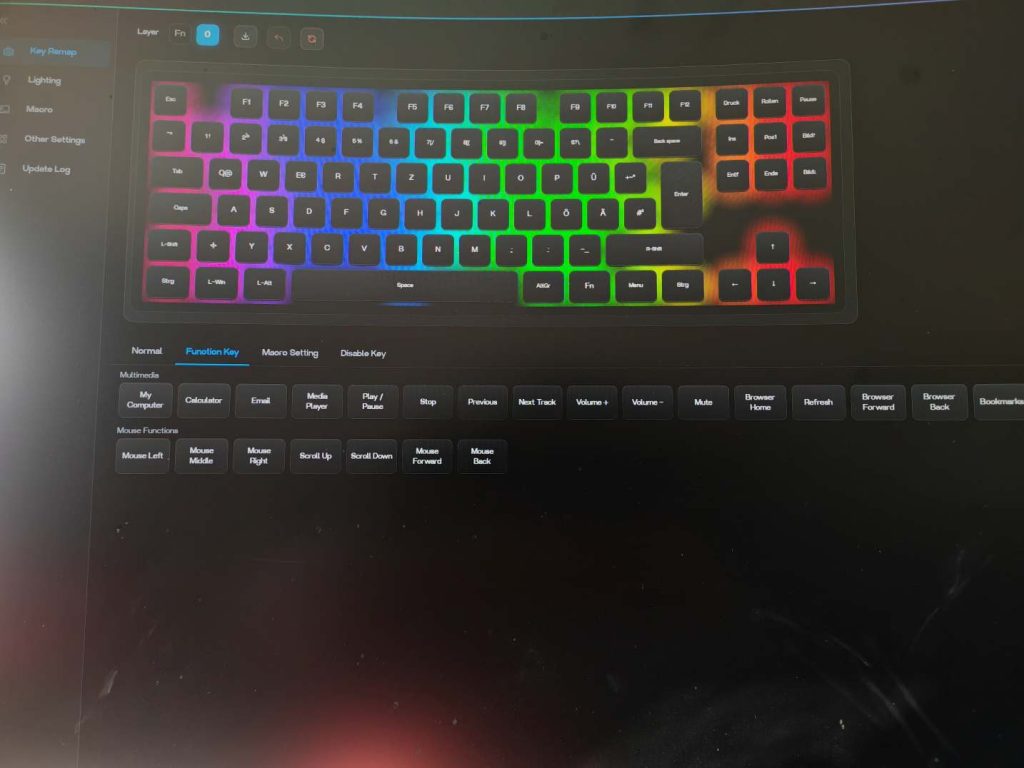
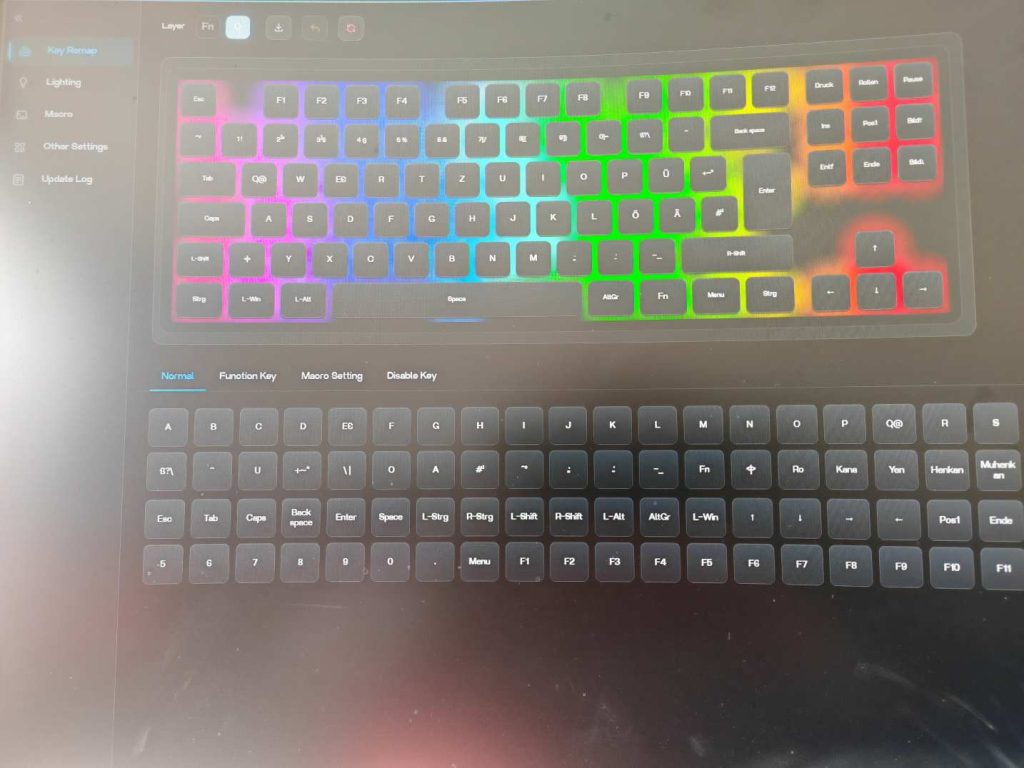
The web-based Epomaker Hub is a dramatic improvement over legacy downloadable drivers: it is clean, platform-agnostic, and completely bloat-free. For 95% of users looking to swap Caps Lock to Control, program work macros, or set up a clean RGB profile, it delivers everything required in seconds.
However, mechanical keyboard purists accustomed to open-source QMK (Quantum Mechanical Keyboard) or VIA/VIAL firmware will note some limitations. The TH87 runs on a proprietary microcontroller rather than an open-source QMK firmware base. This means advanced, niche firmware features like “Tap-Dance” (triggering different commands on single-tap, double-tap, and hold), home-row modding arrays, or compiling custom C-code matrix files directly from GitHub are not supported here. Whilst this won’t bother mainstream users or general office workers, power users who demand full open-source firmware governance should take note.
Hot-Swap Customisation and Modding Potential
Whilst the Epomaker TH87 is an exceptionally competent pre-built keyboard out of the box, it is also designed to serve as an accessible platform for future modding and experimentation.
The circuit board features universal 5-pin hot-swappable switch sockets. These sockets accommodate virtually any standard MX-style mechanical switch on the market, including 3-pin plate-mount switches and 5-pin PCB-mount switches from brands like Gateron, Cherry, Kailh, Outemu, Akko, and Durock. Because the sockets accept 5-pin switches natively, users never need to use clippers to snip off plastic stability legs when upgrading to enthusiast switches.
          [ Switch Stem & Upper Housing ]
                        │
                        ▼
       [ Universal Hot-Swap Switch Socket ]
     ┌────────────────────────────────────────┐
     │  ( ) Left Pin Skt     Right Pin Skt ( )│
     │                 [Center]               │
     │  (•) Plastic Leg        Plastic Leg (•)│
     └────────────────────────────────────────┘
                        │
                        ▼
       [ South-Facing Surface-Mount RGB LED ]
     (Positioned below the switch stem channel,
      eliminating interference with Cherry-profile keycaps)
Furthermore, the LEDs are oriented in a south-facing configuration. On older or budget keyboards with north-facing LEDs, the raised plastic housing of the LED can physically collide with the internal sloping wall of thick Cherry-profile keycaps on the home row (the ASDF cluster), causing a mushy, clipped bottom-out. The TH87’s south-facing LEDs position the diode along the bottom edge of the socket, guaranteeing 100% mechanical clearance with any aftermarket Cherry, OEM, MT3, or SA-profile keycap set you might choose to install in the future.
For users wishing to perform deep acoustic modifications (such as tempest tape-modding or testing custom Poron switch pads), opening the TH87 chassis is straightforward. Unlike some budget boards that use brittle, glue-welded plastic tabs that snap upon opening, the TH87 uses standard Phillips-head screws concealed beneath the rubber foot pads alongside durable snap tabs that can be gently separated using a plastic spudger or guitar pick.
Studio Photography & Visual Staging Recommendations
For tech reviewers, hardware bloggers, and desk setup creators staging the Epomaker TH87 for high-resolution visual reviews, the keyboard’s materials and form factor present specific visual characteristics worth accommodating:
-
Combating Specular Glare on Matte PBT: Because the keycaps are constructed from dense, fine-textured PBT, direct hard strobe light will create hot spots across the alphanumeric legends. Position a large 60×90cm softbox fitted with double diffusion overhead at a 45-degree angle, bouncing a large white foam core reflector board on the opposite side to gently fill shadow valleys across the key profiles.
-
Highlighting the Lateral Ambient Glow: Capturing the subtle illumination of the lateral light strips alongside the south-facing switch backlights requires balanced ambient/strobe exposure ratios. Set your camera on a sturdy geared tripod, lock the shutter at 1/2s to 1s at f/8 and ISO 100, and fire a low-powered rim flash (1/64 power) fitted with a honeycomb grid behind the rear edge. This maintains sharp edge separation along the ABS casing whilst allowing the long exposure to saturate the warm underglow across your desk mat.
-
Macro Framing on the ISO Cluster: Ensure your review gallery includes an authentic 90mm or 105mm macro close-up focused squarely on the junction between the double-height ISO Return key, the
@symbol, and the shortened Left Shift. For British readers evaluating online reviews, this tight macro shot provides immediate visual confirmation of proper legend alignment, font thickness, and ISO tooling quality.
Competitive Comparison: The ISO-UK Market Landscape
To understand why the Epomaker TH87 stands out, it is essential to compare it against its primary competitors in the wireless tenkeyless space:
1. Epomaker TH87 vs. Keychron V3 Max (ISO-UK)
-
Chassis & Mount: Both feature plastic enclosures with gasket mounting. The Keychron V3 Max offers slightly more plate bounce, but the TH87 features a more comprehensive, deeper 5-layer acoustic dampening package.
-
Battery Capacity: The Keychron V3 Max includes a 4,000mAh battery. The TH87 packs a 10,000mAh battery—delivering more than double the wireless runtime when operating with active lighting.
-
Firmware: Keychron wins on firmware by offering native open-source QMK/VIA support. The TH87 relies on its proprietary Epomaker Hub web driver, which is equally fast for basic remaps but lacks deep open-source script compiling.
-
Acoustics Out of the Box: The TH87 with Creamy Jade switches sounds noticeably deeper, richer, and more “thocky” out of the box than the V3 Max, which tends to sound clackier and more hollow unless manually modded.
2. Epomaker TH87 vs. Logitech G515 LIGHTSPEED TKL
-
Form Factor & Feel: The Logitech G515 is an ultra-slim, low-profile keyboard. Whilst it looks sleek, its shallow travel distance (1.3mm actuation) provides a substantially less tactile, less cushioned typing experience compared to the full-travel gasket suspension of the TH87.
-
Customisation: The G515 uses proprietary, non-hot-swappable switches and thin keycaps with limited replacement options. The TH87 is fully modular, featuring 5-pin hot-swap sockets and universal Cherry-profile compatibility.
-
Price Point: The Logitech G515 retails around £139, whereas the Epomaker TH87 routinely retails between £75 and £90, offering dramatically superior typing acoustics and battery longevity for significantly less expenditure.
3. Epomaker TH87 vs. Akko 5087S (ISO)
-
Connectivity: The Akko 5087S ISO is predominantly a wired-only keyboard in this price bracket. The TH87 provides complete tri-mode freedom with rock-solid 2.4GHz wireless and multi-device Bluetooth.
-
Sound Dampening: Akko utilises basic tray-mounting or stiff sandwich dampening, whereas the TH87 employs a modern flex-cut PC plate suspended on silicone gaskets, resulting in a softer, more fatigue-free typing feel.
Pros and Cons
What We Liked
-
Authentic ISO-UK Layout: Zero compromises for British typists; features the genuine double-height Return key, short Left Shift, and correctly mapped UK secondary punctuation legends.
-
Remarkable 10,000mAh Battery: Provides genuine month-long wireless endurance with RGB off, easily doubling or tripling the battery capacity of most competing keyboards.
-
Enthusiast-Tier Acoustic Stack: The 5-layer internal dampening array produces a dense, marbly, thocky acoustic profile with zero hollow case ping or metallic echo.
-
Superb Factory Lubrication: Both the Creamy Jade linears and the Sea Salt Silent V2 switches glide effortlessly, paired with plate stabilisers that exhibit zero wire rattle.
-
Zero-Install Web Driver (Epomaker Hub): Cloud-hosted WebHID configuration in Chrome and Edge allows instant key remapping and macro programming without downloading system-tray bloatware.
-
South-Facing Hot-Swap PCB: Universal 3-pin and 5-pin switch compatibility with no physical interference against aftermarket Cherry-profile keycaps.
-
Refined Lateral Underglow: Dual diffused side light strips wash the desk surface in gentle ambient light without causing glare.
What Could Be Improved
-
ABS Plastic Chassis: Whilst structurally solid and free from creaks, users who demand the weighty, cold-metal presence of CNC-machined aluminium will find the plastic shell lightweight by comparison.
-
No Native QMK/VIA Firmware: The Epomaker Hub is excellent for standard remapping, but power users who rely on custom C-code compilation, tap-dance actuation, or advanced matrix layering will miss open-source firmware.
-
No Integrated Rotary Knob: Unlike the 75% Epomaker TH80 Pro, the TH87 maintains traditional TKL cluster spacing and foregoes a hardware volume roller or media knob.
-
Non-Shine-Through Keycaps: The thick PBT dye-sub keycaps block backlighting from passing through the letterforms, meaning key legends are not illuminated in a pitch-black room (though the ambient underglow remains vibrant).
Final Verdict
The mechanical keyboard industry has long treated the UK market with indifference, leaving British typists to navigate a sea of ANSI-centric designs or settle for stripped-down, hollow ISO adaptations sold at inflated prices.
The Epomaker TH87 ISO-UK represents a masterclass in how to build a regional product right. By marrying an authentic, uncompromised 87-key British layout with modern custom keyboard design—cushioned flex-cut gasket mounting, an intricate five-layer acoustic stack, flawlessly tuned stabilisers, and smooth, factory-lubed switches—it delivers an out-of-the-box typing experience that rivals hand-built custom keyboards. Add in a monumental 10,000mAh battery that eliminates wireless charging anxiety and a hassle-free, browser-based WebHID configuration tool, and you have a peripheral that excels in virtually every discipline.
For UK writers, software developers, corporate professionals, and gamers looking for a refined, wireless tenkeyless mechanical keyboard under £90, the Epomaker TH87 is not just a solid purchase—it is currently the benchmark to beat in its price class.
TNC Score
4.2/5.0