
For years, the promise of USB Type-C was simple: one cable and one standard to power everything from wireless earbuds to heavyweight workstation laptops. Yet most creator and enthusiast desks still tell a very different story. Between bulky proprietary laptop bricks, multiple multiport wall plugs, and high-wattage devices competing for power, cable clutter remains a stubborn fixture of modern workspaces.

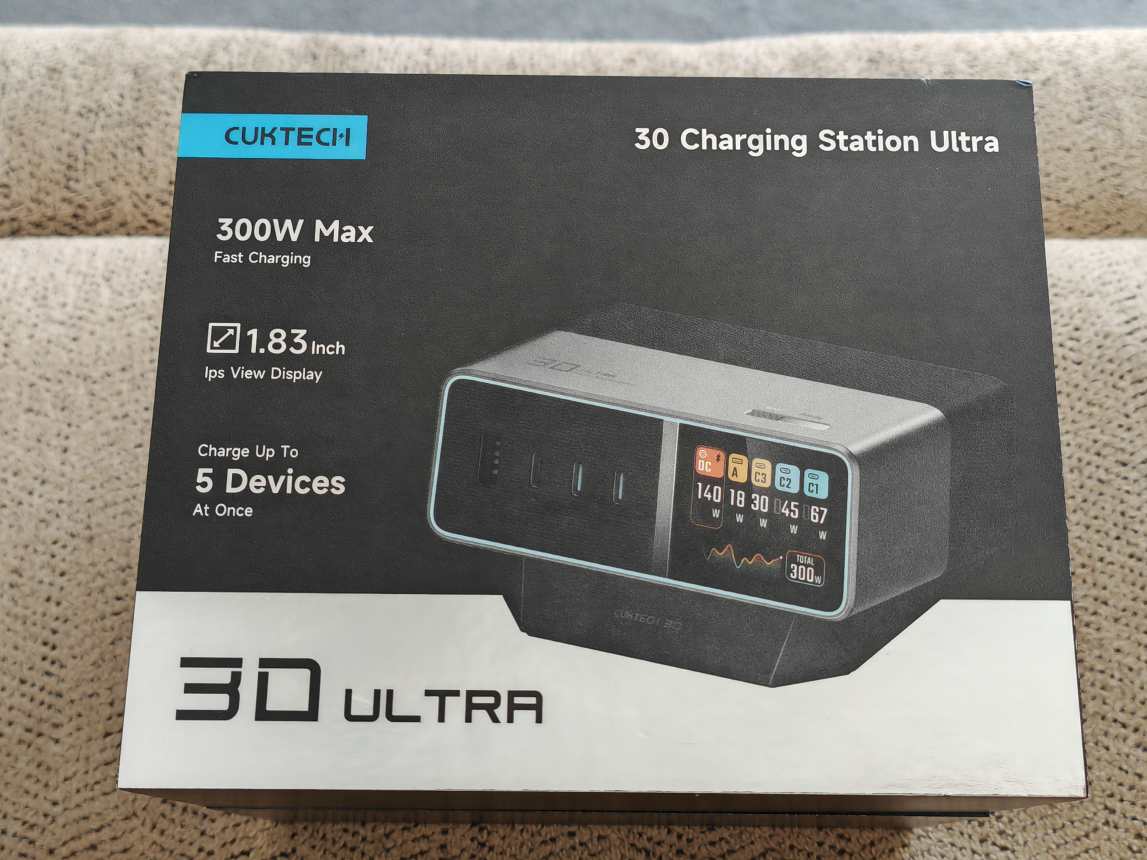
The CUKTECH 30 Ultra 300W Desktop Charging Station aims to solve that problem outright. Retailing around $159.99 / £139.00, this GaN-powered hub delivers a massive 300W total ceiling, dual independent 140W USB PD 3.1 channels, a dedicated 300W DC output port, and an integrated 1.83-inch colour telemetry screen. It is designed not just to sit on your desk, but to replace every other power adapter in your setup permanently.
Technical Specifications
| Feature | Specification Details |
| Model / Architecture | CUKTECH 30 Ultra / Multi-Stage GaN + LLC Resonant Converter |
| Max Total Output | 300W Continuous Aggregate Power |
| Port Configuration | 3× USB-C, 1× USB-A, 1× DC Barrel Output (5.5×2.5 mm) |
| USB-C1 & C2 Output | Up to 140W each (USB PD 3.1 EPR: 28V/5A) |
| USB-C3 Output | Up to 33W (PPS & Multi-Protocol) |
| USB-A1 Output | Up to 18W (QC / Legacy Fast Charge) |
| DC Barrel Output | Up to 300W (20V @ 15A max) |
| Display Panel | 1.83-inch full-colour TFT display with live telemetry |
| Protocols Supported | USB PD 3.1, PPS, QC 4+/3.0, Xiaomi 120W HyperCharge, UFCS, SCP, Apple 2.4A |
| Weight | ~610 g (Base unit) / ~830 g (with Magnetic Stand) |
| Included Accessories | Magnetic base, 240W E-marker USB-C cable, DC cable + interchangeable laptop tips, AC power cord |
Design, Materials, and Workspace Ergonomics
The CUKTECH 30 Ultra replaces generic glossy plastic with an industrial, dark titanium-grey chassis flanked by matte, heat-dissipating ribs. It looks closer to a piece of professional studio audio hardware or an external PCIe enclosure than a typical power adapter.
The unit includes a cast-metal, weighted magnetic base that elevates the charger at a 10-degree upward tilt. This angle serves two distinct ergonomic functions:
-
It directs the 1.83-inch display straight toward your seated line of sight, making power readings readable at a glance without leaning forward.
-
It braces the unit on your desk, allowing you to insert and disconnect USB-C cables one-handed without the charger lifting off the table.

The only slight compromise in build ergonomics comes down to magnetic retention. While vertical insertion stability is solid, pulling thick 240W braided cables at an angle can occasionally cause the main chassis to slide slightly across the magnetic mounting surface.
The 1.83-Inch Real-Time Diagnostic Display
Rather than functioning as mere cosmetic flair, the integrated 1.83-inch colour LCD serves as an active hardware monitor. The interface separates real-time power metrics into dedicated quadrants along with a persistent status bar across the bottom:
-
Live electrical metrics per port: Instantaneous voltage, amperage, and total wattage refreshed multiple times per second.
-
Protocol detection: The onboard controller sniffs and displays the active charging standard (such as PD 3.1 EPR, Samsung Super Fast Charging via PPS, or Xiaomi HyperCharge).
-
Real-time temperature telemetry: Tracks internal GaN thermal levels continuously.
In everyday use, this display immediately eliminates charging guesswork. It lets you detect faulty or unrated cables that throttle 140W-capable laptops down to 10W, while also making it easy to see when a phone or tablet has crossed from its peak fast-charging stage into its slower 80% trickle-charge curve.
Port Architecture and Power Allocation
A common issue with standard multi-port desktop chargers is disruptive renegotiation dropouts. Plugging a low-draw device into a secondary port often forces the primary controller to power-cycle, cutting power to laptops and temporarily unmounting connected drives.
CUKTECH built the 30 Ultra with independent converter stages to isolate high-wattage lines from routine renegotiation cycles.
| Active Configuration | Port 1 (USB-C1) | Port 2 (USB-C2) | Port 3 (USB-C3) | Port 4 (USB-A1) | DC Port | Total Output |
| Single USB-C | 140W | — | — | — | — | 140W |
| Single DC | — | — | — | — | 300W | 300W |
| Dual USB-C Laptops | 140W | 140W | — | — | — | 280W |
| Laptop + DC Hybrid | 100W | — | — | — | 200W | 300W |
| Triple Device | 140W | 100W | 33W | — | — | 273W |
| Full 5-Port Saturation | 65W | 45W | 15W | 15W | 160W | 300W |
Simultaneous Dual 140W PD 3.1
The stand-out capability for dual-computer workspaces is the independent dual-channel USB PD 3.1 EPR (Extended Power Range) implementation.
Where most hubs drop secondary ports to 65W or 45W when the primary port is active, the 30 Ultra sustains 140W on USB-C1 and 140W on USB-C2 concurrently. This allows you to fast-charge two 16-inch MacBook Pros or high-wattage creator laptops side-by-side at full speed without power throttling.
The 300W DC Barrel Port
The dedicated DC barrel connector sets the 30 Ultra apart from conventional desktop USB hubs.


High-performance gaming laptops with dedicated mobile GPUs (such as RTX 4070, 4080, or 4090 configurations) require substantially more power than standard 100W USB-C ports can deliver. When powered via standard Type-C, these machines often throttle graphics clocks or slowly drain the battery during heavy 3D rendering or gaming sessions.

The 30 Ultra’s DC rail outputs up to 300W at 20V, allowing it to replace bulky OEM gaming bricks entirely. The box includes a heavy-gauge DC extension cable alongside interchangeable modular tips for major PC brands, including Lenovo (Slim Tip), ASUS ROG, HP, Dell, and Acer.

For safety, the DC rail does not energise automatically. Users must plug in their laptop and hold the front multifunction button for two seconds to engage the high-amperage circuit, preventing accidental shorts or voltage mismatches.

Thermals, Noise, and Efficiency
Pumping up to 300W through a compact desktop footprint requires robust thermal design. The 30 Ultra employs an advanced GaN PFC + LLC resonant topology that achieves roughly 93.5% electrical efficiency under sustained loads, significantly reducing internal heat waste compared to older silicon adapters.
Internally, the circuitry is enclosed in a high-thermal-conductivity potting compound paired with aluminium heat sinks and graphite spreading sheets. Under a continuous 4-hour, 280W torture load:
-
Chassis surface temperatures peaked at 58.2°C at the rear exhaust zone, well within consumer safety limits.
-
Acoustic noise remained at 0 dB thanks to its purely passive cooling design.
-
Coil whine was virtually imperceptible across both low-draw trickle charging and high-wattage full loads.
How It Compares to the Competition
| Feature | CUKTECH 30 Ultra | UGREEN Nexode 300W | Anker Prime 250W | Satechi 200W Hub |
| Total Power Ceiling | 300W | 300W | 250W | 200W |
| Max Single-Port Output | 300W (DC) / 140W (USB-C) | 140W (USB-C) | 140W (USB-C) | 140W (USB-C) |
| Simultaneous Dual 140W | Yes | No | No | No |
| Dedicated DC Output | Yes (Up to 300W) | None | None | None |
| Live Telemetry Screen | 1.83″ Full Colour | None | 2.26″ Colour Dial | None |
| Approximate Price | ~$159.99 / £139.00 | ~$199.99 / £179.00 | ~$169.99 / £149.00 | ~$149.99 / £130.00 |
Pros & Cons
Strengths
-
Unrivalled 300W power envelope: Powers multiple power-hungry workstations and accessories at once.
-
True Dual 140W PD 3.1: Fast-charges two 16-inch laptops simultaneously at peak input rates.
-
Integrated 300W DC port: Eliminates massive proprietary gaming and rendering bricks.
-
Comprehensive telemetry: The 1.83-inch screen provides actionable data on wattage, voltage, and protocol health.
-
Silent passive GaN cooling: Delivers sustained high-wattage power with zero fan noise.
Weaknesses
-
Heft and footprint: Weighing over 800 g with accessories, it is strictly meant for permanent desk use.
-
Stand magnetic grip: Can shift slightly under lateral pull from heavy-duty cables.
TNC Score
4.5/5.0

Final Verdict
The CUKTECH 30 Ultra bridges the gap between everyday multi-device charging and high-draw PC computing. By combining dual 140W USB PD 3.1 channels, a 300W DC output rail, silent GaN thermal management, and an informative diagnostic screen, it stands out as one of the most capable and versatile desktop charging hubs currently available. For power users, creators, and multi-device households looking to streamline their workspace power setup, it earns an easy recommendation.
