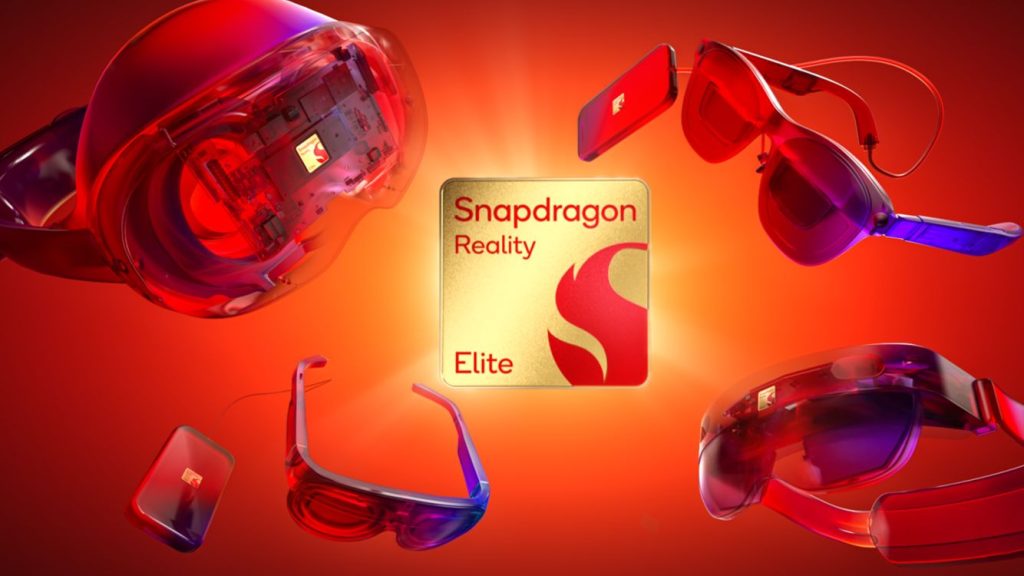
Qualcomm just pulled back the curtain at the Augmented World Expo (AWE), and they are not playing around. Say hello to the Snapdragon Reality Elite Platform, a purpose-built XR chipset designed to power the next generation of spatial computing.
Whether you are tracking high-performance, all-in-one Video-See-Through (VST) headsets or lightweight, tethered Optical-See-Through (OST) glasses, Qualcomm is aiming to become the undisputed silicon backbone of the XR universe.
With over 60 million XR devices already in the wild, the market is maturing fast. As Ziad Asghar, SVP and GM of XR, Wearables and Personal AI at Qualcomm, put it:
“Demand is increasing for XR technologies that deliver higher performance, greater intelligence, and improved power efficiency. Snapdragon Reality Elite is designed to meet those demands with powerful on-device AI… reinforcing our leadership in VR and MR.”
Here is a breakdown of why this chip is a massive deal for developers, hardware geeks, and tech enthusiasts alike.
Designed for Generative AI (Yeah, 48 TOPS)
We’ve seen AI take over phones and PCs, and now it’s fully embedding itself into spatial computing. The Snapdragon Reality Elite packs a staggering 48 TOPS (Trillion Operations Per Second) of on-device AI performance.
This isn’t just a marketing buzzword. This local NPU horsepower is built to run Large Language Models (LLMs) and Large Vision Models (LVMs) directly on the headset. What does that mean in practice?
-
Photorealistic Avatars: Built-in support for rendering lifelike avatars using Gaussian Splatting.
-
Dynamic Environments: Real-time, LVM-driven object generation that lets the headset understand your room and spawn digital content that interacts naturally with physical objects.
-
Contextual Agents: LLM-powered AI assistants that see what you see and help you navigate both work and play.
-
Flawless Tracking: Massive AI upgrades to head and hand tracking, alongside ultra-low-latency see-through features.
The Spec Sheet: “XR Superpowers”
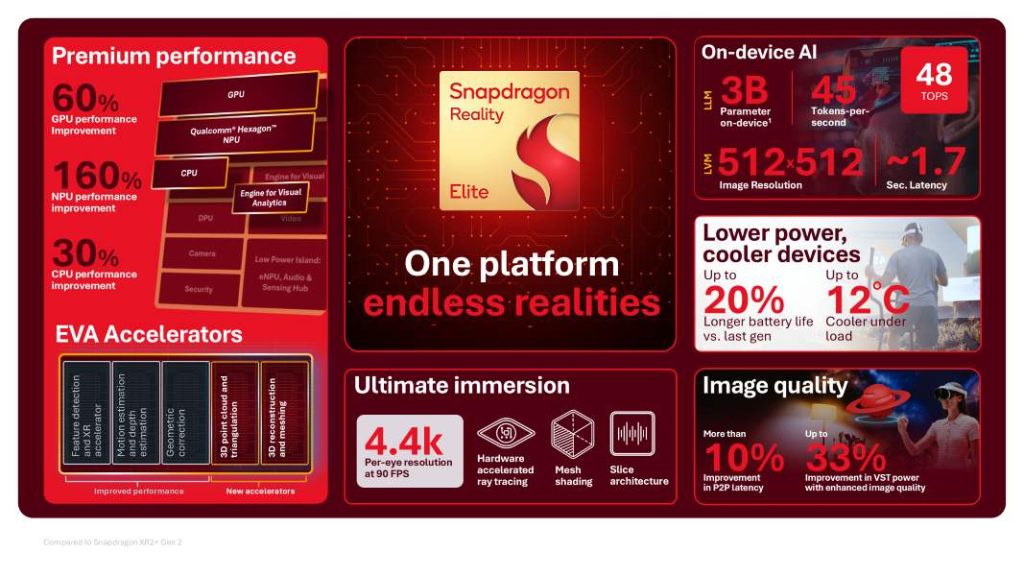
Qualcomm didn’t just iterate; they threw down some serious hardware gains. When compared to previous generations, the silicon leaps are massive:
| Metric | Upgrade / Performance Spec |
| NPU Performance | Up to 160% increase |
| GPU Performance | Up to 60% increase |
| CPU Performance | Up to 30% increase |
| Resolution Support | Up to 4.4K per eye @ 90 FPS |
| Thermal Improvement | Runs up to 12°C cooler under load |
| Battery Life | Up to 20% longer lasting at the same workload |
To handle the immense computational demands of computer vision tasks without draining the battery, Qualcomm implemented IP hardening via a dedicated EVA block. This hardware acceleration natively handles demanding spatial perception tasks, keeping things smooth and responsive.
Thermal Comfort is the Real Win
Let’s be honest: nobody wants a toaster strapped to their face. The 12°C drop in temperature and 20% battery efficiency boost mean OEMs can finally build lighter, slimmer form factors that users can comfortably wear for hours, not minutes.
Powering the Ecosystem (Android XR, XREAL, and Beyond)
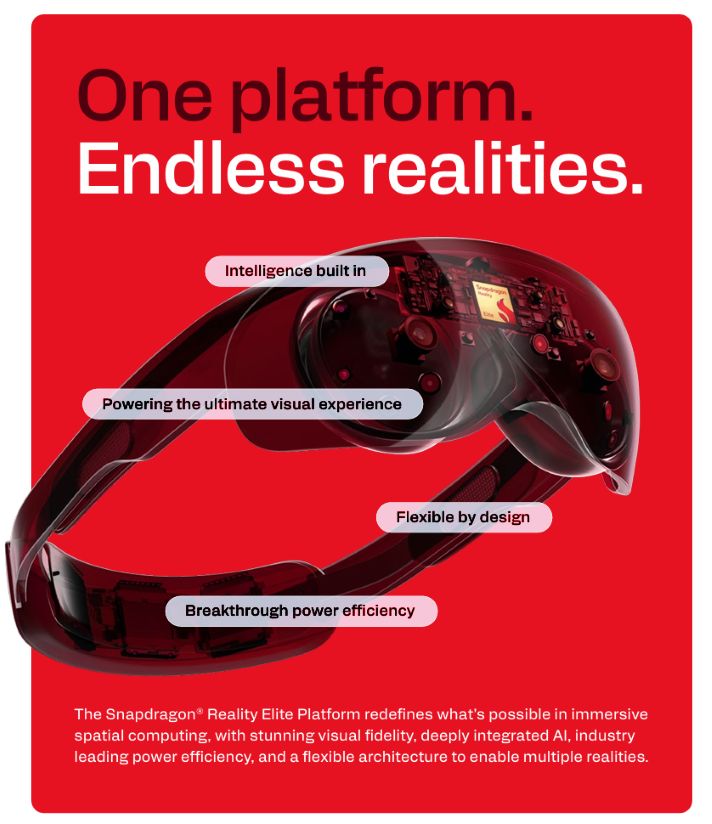
Qualcomm isn’t building this chip in a vacuum; it’s designed to sit at the absolute core of the XR ecosystem, including tight integration with Android XR.
Two major players have already raised their hands to anchor their upcoming flagship devices on the Reality Elite:
XREAL Project Aura
Launching later this year, Project Aura aims to set a new benchmark for optical see-through XR glasses. Chi Xu, Co-founder and CEO of XREAL, noted that the platform provides the exact “performance, efficiency, and advanced on-device AI capabilities” needed to bridge premium consumer expectations with developer demands.
Play for Dream
The immersive device manufacturer has officially adopted the platform for their next-generation hardware to push high-quality, high-fidelity mixed reality experiences.
The Takeaway
The Snapdragon Reality Elite is a clear signal that the spatial computing race is shifting from “Can we make this work?” to “How smart and beautiful can we make it?” By pairing raw graphical gains (4.4K per eye) with specialised AI silicon (48 TOPS), Qualcomm is giving developers the exact sandbox they need to build the actual metaverse—or whatever we’re calling it this week.
Keep your eyes peeled. With hardware hitting the market later this year, the next wave of MR headsets is about to get a whole lot lighter, cooler, and infinitely smarter.
More stories