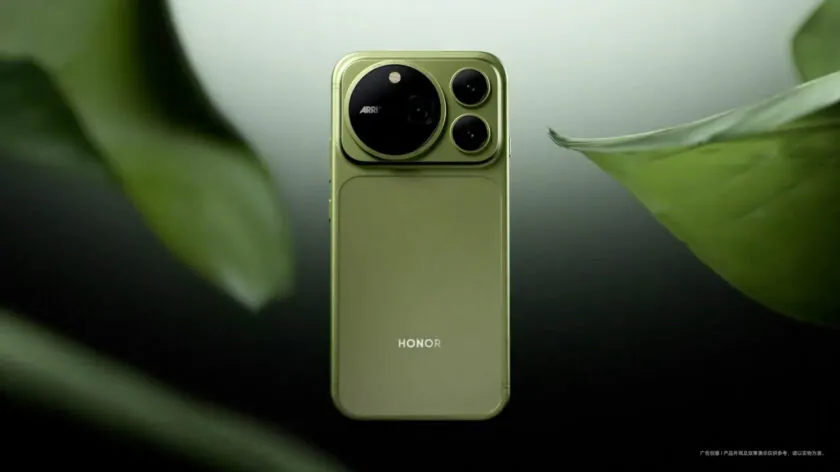
The smartphone industry has spent the better part of half a decade locked in a cycle of iterative refinement. Year after year, keynote presentations trumpet incremental percentage gains in peak CPU frequencies, marginally brighter displays that throttle down after thirty seconds in direct sunlight, and camera bumps that swell in size without fundamentally altering how mobile media is captured, processed, or finished.
Honor’s launch event in Shenzhen fundamentally broke that cycle. Rather than contenting itself with standard platform migrations, the company unveiled the Honor Magic 9 Series, headlined by a hardware and software collaboration with legendary cinema camera manufacturer ARRI. In doing so, Honor dismantled its signature centred “Star Wheel” camera island in favour of an asymmetric, production-oriented chassis, rewrote the rules of mobile battery density with its fourth-generation Qinghai Lake silicon-carbon cells, and shocked attendees with a secret third device: the active-cooled, 11,000mAh Honor Magic 9 Super Edition.
The resulting lineup—spanning the compact Magic 9, the cinema-grade Magic 9 Pro Max, and the endurance-focused Magic 9 Super Edition—represents an aggressive bid to split the premium market into distinct specialised form factors.

Architectural Philosophy: The ARRI Optical Alliance
To understand the headline model, the Honor Magic 9 Pro Max, one must look back at historical industrial cinematography. For years, mobile phone camera arrays have struggled with optical parallax: the physical distance between distinct lenses causes jarring perspective jumps and framing shifts whenever a user zooms between wide, primary, and telephoto focal lengths during live recording.
Honor’s solution was to partner directly with ARRI (Arnold & Richter Cine Technik), the century-old German cinema titan whose equipment has captured the vast majority of Academy Award-winning cinematography over the past several decades.
Rather than treating the partnership as a mere branding exercise consisting of pre-baked colour filters and a logo stamped on the back glass, the engineering teams rethought the internal physical packaging of the device. The rear camera module discards symmetry entirely. Directly inspired by the mechanical optical layout of the iconic 1937 ARRIFLEX 35—which pioneered the rotating mirror reflex shutter and grouped lenses on a compact turret to keep optical axes clustered—the Magic 9 Pro Max clusters its primary 200MP sensor and its 200MP periscope telephoto along a tight horizontal imaging plane on the upper-left flank.
By minimising the physical baseline between the two largest sensor cavities, Honor’s imaging algorithms can execute smooth rack-focus shifts and continuous electronic focal transitions without the violent parallax perspective warping that typically betrays smartphone footage.
Surrounding this primary optical cluster is a precision aerospace-grade titanium alloy frame, micro-milled to support physical modular accessories. For the first time on an Honor flagship, the camera bezel is not merely protective trim; it features a recessed mechanical bayonet locking ring, laying the foundation for an unprecedented modular camera ecosystem.
Deep Dive: Comprehensive Series Hardware Matrix
To appreciate the distinct engineering targets across the family, examining the raw hardware specifications reveals stark differences in thermal management, optical payloads, silicon architectures, and power delivery:
| Specification | Honor Magic 9 (Standard) | Honor Magic 9 Pro Max | Honor Magic 9 Super Edition |
| Market Segment | Compact Everyday Flagship | Professional Mobile Cinema & Imaging | Extreme Endurance & Sustained Compute |
| Dimensions & Weight |
157.2 × 71.8 × 7.8 mm
189 grams |
162.8 × 76.3 × 8.4 mm
224 grams |
163.4 × 76.8 × 8.1 mm
232 grams |
| Chassis Materials | Armor Glass, Aluminium Midframe | Nanocrystal Glass 3.0, Grade 5 Titanium Frame | Shield Ceramic-Glass, Magnesium-Aluminum Alloy |
| SoC / Compute Platform | Qualcomm Snapdragon 8 Elite Gen 5 (3nm) | Qualcomm Snapdragon 8 Elite Extreme Gen 6 (2nm GAA) | Qualcomm Snapdragon 8 Elite Gen 5 (3nm) |
| Dedicated Co-Processors | Honor E2 Power Efficiency Chip |
• Honor Drive H1 Cinema NPU (6nm, 18.8 TOPS/W)
• Honor E2 Power Chip
• Discrete 3D Biometric Security Core |
Honor E2 Power Management Chip |
| Thermal Dissipation | Jade Plate Vapour Chamber 2.0 (3,800 mm²) | Jade Plate 3D Liquid Bionic Vapour Chamber (5,200 mm²) | Micro-Centrifugal Active Impeller Fan (18,000 RPM) + Ultra-Thin Vapour Chamber |
| Display Panel | 6.37-inch Flat OLED | 6.80-inch Quad-Curved LTPO OLED | 6.81-inch Completely Flat 2.5D OLED |
| Resolution & Density | 2664 × 1236 pixels (~458 ppi) | 2868 × 1320 pixels (~460 ppi, 1.5K+) | 2788 × 1280 pixels (~442 ppi) |
| Refresh & Touch Rate | 1–120Hz LTPO, 360Hz Touch | 1–120Hz Dynamic LTPO, 480Hz Touch | 60/90/120Hz Discrete, 480Hz Touch |
| PWM Dimming Frequency | 3,840Hz Ultra-High Frequency | 4,320Hz Zero-Flicker Risk PWM | 3,840Hz Ultra-High Frequency |
| Peak Display Luminance | 10,000 nits Local HDR / 1,800 nits HBM | 6,000 nits Local HDR / 2,000 nits Full-Screen HBM | 10,000 nits Local HDR / 2,200 nits Full-Screen HBM |
| Primary Rear Camera | 200MP (1/1.56″, f/1.8, 23mm, Dual-Pixel PDAF, OIS) | 200MP OmniVision OV52A (1/1.28″, f/1.57, 23mm equivalent, 3-axis Gimbal OIS ±3°, CIPA Level 8.0) | 200MP Samsung S5KHP5 (1/1.55″, f/1.8, 24mm equivalent, PDAF, standard OIS) |
| Telephoto Camera | 200MP Periscope (1/1.4″, f/2.6, 85mm equivalent, 3.7x optical, OIS) | 200MP Samsung S5KHPE Periscope (1/1.4″, f/2.6, 95mm equivalent, 4.1x optical, Macro-capable, CIPA Level 8.0 OIS) | 50MP Sony LYTIA 500 (1/2.93″, f/2.4, 75mm equivalent, 3.1x optical, OIS) |
| Ultra-Wide Camera | 50MP (f/2.0, 12mm equivalent, 122° FOV, 2.5cm Macro AF) | 50MP (f/2.0, 12mm equivalent, 122° FOV, Dual-Pixel AF, 2.5cm HD Macro) | 12MP (f/2.2, 14mm equivalent, 116° FOV, Fixed Focus) |
| Front Selfie Camera | 50MP Wide (f/2.0, 21mm, 4K/60fps video) | 55MP Square Sensor (1:1 Aspect Ratio, f/2.0, 20mm) + 3D Structured Light ToF Sensor | 50MP Wide (f/2.2, 22mm, 4K/30fps video) |
| Battery Chemistry & Size | 8,000mAh Qinghai Lake Silicon-Carbon (4th-Gen) | 8,800mAh Qinghai Lake Silicon-Carbon Blade Array | 11,000mAh Ultra-High-Silicon Anode Cell (~1000Wh/L) |
| Wired Charging | 80W Honor SuperCharge | 100W Honor SuperCharge (PPS / USB-PD 3.0 backwards compatible) | 80W Honor SuperCharge |
| Wireless Charging | 50W Wireless SuperCharge | 80W Wireless SuperCharge (Reverse Wireless 15W) | 50W Wireless SuperCharge |
| Audio Hardware | Dual Symmetrical Stereo Speakers, 3 Mic Array | Dual 1216 Box Stereo Speakers, Studio-Tuned Hardware Shotgun (“Gun”) Mic + 4 Array Mics | Dual Stereo Speakers, Dual Mic Array |
| Ingress Protection | IP68 / IP69K | IP68 / IP69K (High-Pressure Hot Water Jet Rated) | IP68 |
| Biometric Security | Ultrasonic In-Display Fingerprint Sensor | Hardware 3D Face ID + 3D Ultrasonic In-Display Scanner | Ultrasonic In-Display Fingerprint Sensor |
| Satellite Connectivity | Optional Beidou Satellite SMS | Dual-Band Tiantong Satellite Voice Calls & Beidou Messaging | Beidou Satellite Two-Way SMS |
| Base Configuration & Price |
12GB RAM + 512GB Storage 4,499 CNY (~$640 USD / £480 GBP) |
16GB RAM + 512GB Storage 6,499 CNY (~$925 USD / £695 GBP) |
16GB RAM + 512GB Storage 5,999 CNY (~$855 USD / £640 GBP) |
The Imaging Suite: Dual 200MP Architecture and the Drive H1 NPU
The core of the Magic 9 Pro Max’s technical narrative is its imaging pipeline. Modern 200MP sensors have historically been relegated to marketing checklists—often serving as tiny-pixel grids that produce smeared images in low light or struggle under sluggish shutter response times due to bandwidth bottlenecks.
Honor addresses this via raw computational horsepower: the custom Honor Drive H1 Cinema NPU. Fabricated on an energy-efficient 6nm process node, the Drive H1 delivers 18.8 TOPS per Watt of dedicated mathematical throughput exclusively to processing Bayer RAW data streams before they reach the main Snapdragon application processor.
Dual 200MP Main and Periscope Synergy
The primary camera employs a massive 1/1.28-inch custom OmniVision OV52A sensor. The optical package features an integrated 3-axis mechanical gimbal stabiliser capable of counteracting up to ±3 degrees of physical angular displacement, achieving a CIPA Level 8.0 stabilisation rating. This level of physical damping enables handheld exposures of up to a full second without micro-blur, and produces tripod-like video stability without relying entirely on aggressive electronic rolling-shutter crop modes.
Operating in lockstep is the periscope telephoto assembly, anchored by the 1/1.4-inch Samsung S5KHPE sensor. In smartphone optics, telephoto sensors have historically been treated as second-class citizens compared to main sensors, shrinking down to diminutive sizes that collapse into noise when twilight arrives. By packing a massive 1/1.4-inch footprint behind a prism-folded optical path, Honor brings primary-grade surface area to long-range photography.
The telephoto element features floating group mechanics, allowing it to transition seamlessly from a 95mm portrait perspective down to a microscopic 5cm close-up macro mode, resolving individual fibres on currency, mechanical watch escapements, and biological textures with remarkable optical fidelity.
Android’s First Square-Format (1:1) Selfie Sensor
On the front glass, nestled inside the pill-shaped cutout next to the 3D Time-of-Flight biometric sensor, lies another mobile industry first: a 55MP square-aspect-ratio (1:1) image sensor.
Standard smartphone selfie cameras employ traditional rectangular 4:3 sensors. This forces a physical dilemma: when streaming or recording in portrait mode (9:16), the software aggressively crops away the horizontal flanks of the sensor. When the user flips the phone horizontally for a video conference or landscape vlog (16:9), the sensor flips, cropping the opposite axes.
Honor’s 1:1 square sensor records an uncropped square field of view natively. The internal camera controller can instantaneously output native 16:9 horizontal, 9:16 vertical, or 1:1 square video streams at full sensor utilisation without shifting field of view or requiring the creator to awkwardly re-aim the phone.
The ARRI Cinema Engine & Production Workflow
The collaboration between Honor and ARRI manifests across four distinct architectural pillars: dynamic range capture, colour space transform, real-time LUT evaluation, and acoustic isolation.
10-Bit ARRI LogC3 and ARRI Wide Gamut 3
When smartphones capture video in standard Rec.709 or even high-dynamic-range HDR10/Dolby Vision containers, aggressive tone-mapping curves permanently bake highlights and shadows into the file, clipping extreme whites and crushing black levels to produce a vivid, “hyper-real” image.
The Magic 9 Pro Max introduces a native ARRI LogC3 capture mode, encoding at 10-bit colour depth with high-bitrate All-Intra compression directly to onboard storage or externally attached USB 3.2 Gen 2 SSDs. By mapping the raw sensor response onto the logarithmic ARRI LogC3 curve within the ARRI Wide Gamut 3 (AWG3) colour space, the camera preserves over 14.5 stops of usable dynamic range.
Highlight roll-off is smooth and cinematic rather than abrupt and digital. Clouds around a midday sun hold gradient texture instead of blowing out into harsh white artefacts, while deep shadows maintain shadow detail without introducing aggressive chroma-denoising smearing.
The Complete ARRI Look Library Integration
For run-and-gun filmmakers who do not plan to colour-grade manually in an external editing suite, Honor integrated the complete ARRI Look Library natively into the Magic 9 Pro Max’s viewfinder interface. This consists of 87 distinct cinematic film looks, alongside 14 instant-access profile presets tuned directly by ARRI colour scientists in Munich.
Because rendering high-precision 3D LUTs over a live 4K/60fps viewfinder stream would typically cause thermal throttling and battery drain on standard GPU architectures, the Honor Drive H1 NPU executes the LUT colour matrix transform entirely in hardware at the RAW-domain level. The 120Hz LTPO display renders the preview with under 8 milliseconds of latency, allowing camera operators to monitor their scenes with accurate contrast, exposure, and colour representations.
Hardware Shotgun (“Gun”) Mic Tuning
Audio capture has long been the Achilles’ heel of mobile videography. The Magic 9 Pro Max tackles this with a specialised physical shotgun microphone integrated into the upper rim of the camera module, tuned with algorithmic directional beamforming.
The interface gives sound designers three discrete hardware capture profiles:
-
Cardioid / Front Focus: The array prioritises a narrow 45-degree cone directly in front of the camera lens, cutting down reflections and ambient street noise behind and to the sides of the device. This provides vloggers and solo operators with clean vocal tracks without requiring clip-on wireless transmitter kits.
-
Omnidirectional Ambient: Utilises the full 4-mic array around the phone’s chassis to record an uncompressed 3D soundstage, capturing spatial ambient sound environments in Dolby Atmos or multi-channel PCM.
-
Dialogue Isolation Mode: Uses neural-network noise filtering running locally on the NPU to dynamically isolate human speech frequencies while suppressing persistent mechanical hums, air conditioning drone, and wind buffeting up to 35 km/h.
The Modular Filmmaking Ecosystem
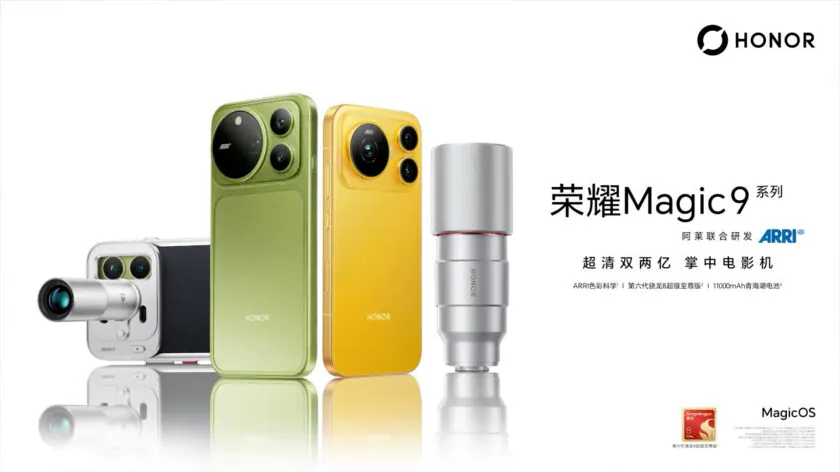
To bridge the gap between a pocket smartphone and a working cinema camera rig, Honor demonstrated an ecosystem of dedicated modular hardware accessories that interface mechanically and electronically with the Magic 9 Pro Max:
G200mm and G500mm Cinema Optical Teleconverters
Using the camera island’s titanium bayonet mount, operators can twist-lock optical add-on teleconverters directly over the 200MP periscope lens module.
Unlike cheap aftermarket universal smartphone lenses held on by plastic friction clips, Honor’s G-Series Teleconverters use precision-ground fluorite and extra-low dispersion (ED) optical glass elements designed to match the optical refraction indices of the internal lens barrel.
-
The G200mm extends the native reach of the periscope module to an equivalent 200mm optical focal length with zero loss of resolving power.
-
The G500mm turns the device into a specialised wildlife and sports monitoring camera. Because the underlying sensor operates at 200MP, operators can crop in further through digital in-sensor zoom, achieving effective focal lengths surpassing 1000mm while preserving clean 4K video resolution.
The Synchronised Focal-Tracking Zoom Flash
Clamping directly into the top accessory shoe of the camera housing, the Honor Sync-Beam Flash features an internal motorised reflector assembly.
As the operator zooms the phone’s interface from ultra-wide (12mm) to standard wide (23mm) and through the telephoto ranges, an integrated stepper motor within the flash housing dynamically adjusts the positioning of the xenon tube relative to its Fresnel lens. At wide angles, the flash spreads a broad, diffused flood of light across a 120-degree arc; at full zoom, the beam tightens into an intense spotlight, throwing illumination dozens of meters into the distance.
The Cinema Rig Power Grip
The physical camera grip connects securely via the USB Type-C port on the phone’s bottom edge while clamping around the chassis rails. The grip supplies:
-
A textured mechanical two-stage shutter release with half-press autofocus lock.
-
An electronic stepless zoom rocker switch allowing variable-speed zooms.
-
A customizable metal rotary wheel mapped by default to manual focus pulling or stepless aperture adjustment.
-
An integrated 3,500mAh auxiliary battery cell housed within the palm swell, trickle-charging the phone to allow continuous 4K/60fps Log recording sessions for over four continuous hours.
Battery Chemistry Breakthrough: 4th-Gen Qinghai Lake and the 11,000mAh Ceiling
Behind the camera headlines lies an equally consequential technological leap: battery chemistry. The lithium-ion polymer pouch cells that have powered portable electronics for three decades have reached an elemental plateau. To increase runtime, manufacturers have historically had only one crude lever: make the phone physically thicker and heavier.
Honor has systematically shifted its flagship devices toward silicon-carbon (Si-C) anodes. In a traditional lithium-ion battery, the anode is made of graphite, which has a theoretical specific capacity limit of roughly 372 mAh/g. Silicon, by contrast, can theoretically achieve up to 4,200 mAh/g. The historic engineering hurdle has been that pure silicon swells by up to 300% in volume during lithiation (charging), which fractures the electrode structure and causes rapid cell death after mere dozens of recharge cycles.
With its 4th-Generation Qinghai Lake Battery, Honor’s materials science division has introduced a porous carbon-nanotube matrix containing micro-engineered silicon particles with a 40% active silicon content, reinforced by an elastic self-healing polymer binder.
This architecture allows the silicon particles to expand and contract microscopically without disrupting the solid electrolyte interphase (SEI) layer or structurally compromising the pouch cell. The result is an energy density approaching an industry-record 1,000 Watt-hours per liter (Wh/L).
-
In the Honor Magic 9 Pro Max, this technology allows an immense 8,800mAh battery to occupy a chassis just 8.4mm thick—providing two full days of heavy flagship productivity or up to 6.5 hours of continuous 4K video recording.
-
In the base Honor Magic 9, an 8,000mAh battery is compressed into an ultra-slim 7.8mm, 189g frame, redefining runtime benchmarks for compact flagships.
The Unannounced Wildcard: Honor Magic 9 Super Edition
The most dramatic moment of the keynote occurred when Honor CEO George Zhao returned to the stage to unveil a device that had completely avoided pre-launch regulatory leaks: the Honor Magic 9 Super Edition.
Where the Magic 9 Pro Max is built for mobile cinematographers and high-end visual artists, the Super Edition is an uncompromised endurance and sustained-compute machine engineered for power users, field technicians, long-distance travellers, and competitive gamers.
An Unprecedented 11,000mAh Power Reservoir
By utilising an even denser, rigid-blade formulation of its silicon-carbon chemistry and re-engineering internal component packaging, Honor managed to fit a staggering 11,000mAh battery into the Super Edition.
Remarkably, the device does not resemble an industrial brick or ruggedised outdoor phone. Measuring just 8.1mm in thickness and weighing 232 grams, the Super Edition is thinner than many conventional flagship smartphones carrying batteries less than half its capacity. In standardised endurance testing, the device yields up to 4 days of moderate-to-heavy use on a single charge, or over 19 hours of continuous screen-on GPS navigation.
Active Miniature Cooling Fan Integration
Squeezing an 11,000mAh battery into an 8.1mm profile while running modern high-current mobile silicon poses an immense thermal challenge. Passive vapour chambers rely on surface-area dissipation through the phone’s glass and metal frame; under heavy combined workloads (such as sustained gaming while fast-charging outdoors), passive heat dissipation inevitably plateaus, forcing the SoC to throttle clock frequencies to protect the battery chemistry.
The Magic 9 Super Edition tackles this with a micro-engineered active cooling impeller fan. Measuring barely 2.4mm in total thickness, this micro-centrifugal fan spins up to 18,000 RPM via an ultra-quiet, brushless magnetic-levitation motor.
The airflow path is entirely sealed off from the main motherboard and battery cavity via a custom structural intake and exhaust duct, preserving the phone’s IP68 water-and-dust ingress protection. Ambient air is drawn through a micro-mesh inlet grille on the side frame, routed directly across a specialised copper fin array bonded to an ultra-thin vapour chamber, and exhausted out the top edge.
This thermal design lowers peak SoC core temperatures by up to 8.5°C under continuous load, allowing the Super Edition to run intensive 3D gaming titles at locked 120 FPS frame rates indefinitely without experiencing a single frame drop or throttling screen brightness.
The Architectural Balance
To fit the micro-fan ducting, internal impeller, and the massive 11,000mAh battery cell, Honor’s hardware engineers made calculated optical trade-offs:
-
The complex, heavy 200MP periscope array of the Pro Max is replaced with a more compact, streamlined 50MP Sony LYTIA 500 3x optical telephoto module.
-
The primary camera moves to a capable, physically thinner 200MP Samsung S5KHP5 sensor.
-
The ultra-wide camera drops from 50MP to a straightforward 12MP sensor.
By making these strategic optical compromises, Honor reclaimed critical internal volume, proving that specialised flagships can prioritise sustained endurance and thermal stability without abandoning high-end industrial design.
Display Technology, Silicon, and OS Architecture
Across the Magic 9 family, Honor has brought significant generational updates to visual ergonomics, core processing, and system software:
Flicker-Free Ergonomic Displays
Honor continues to lead the industry in display-driven eye comfort. The Magic 9 Pro Max features a 6.80-inch quad-curved LTPO panel operating at an astonishing 4,320Hz ultra-high-frequency PWM dimming. This eliminates visible and invisible stroboscopic flicker across all brightness levels, dramatically reducing visual fatigue and eye strain during late-night reading or editing sessions.
For outdoor usability, the displays utilise next-generation luminous materials capable of hitting a localised HDR peak brightness of 10,000 nits on the standard Magic 9 and Super Edition, and 6,000 nits on the Pro Max. Crucially, the full-screen High Brightness Mode (HBM) can sustain 2,000 to 2,200 nits across the entire panel under direct sunlight, ensuring complete visibility even in harsh desert or snow environments.
The 2nm Snapdragon 8 Elite Extreme Architecture
Powering the Magic 9 Pro Max is the world’s first commercially deployed 2nm gate-all-around (GAA) processor: the Qualcomm Snapdragon 8 Elite Extreme Gen 6.
Featuring custom Oryon CPU cores configured in an all-big-core architecture—dropping efficiency cores entirely in favour of an ultra-high-performance cluster paired with balanced performance cores—the chipset achieves a 35% boost in IPC efficiency and a 44% uplift in GPU compute density while lowering overall power consumption.
The standard Magic 9 and the Magic 9 Super Edition leverage the mature 3nm Snapdragon 8 Elite Gen 5, offering flagship-tier performance that pairs efficiently with their massive battery capacities.
MagicOS 10: System-Level Multimodal Intelligence
All three devices launch with MagicOS 10, built atop the Android open platform. MagicOS 10 introduces deep, kernel-level scheduling routines governed by the Honor Phantom Engine 3.0, which predicts frame delivery times down to the microsecond level to eliminate micro-stutter while dynamically cutting background draw calls.
The OS also introduces expanded multimodal on-device AI tools:
-
Real-Time Cinematic Transcription: Transcribes multi-speaker interviews captured through the ARRI Gun-Mic setup in real time, auto-generating synchronised subtitle tracks embedded directly into video metadata.
-
Semantic Footage Search: Users can query their gallery using natural, colloquial language (e.g., “Find the take where the dog jumped over the puddle at sunset”), processing thousands of hours of local footage via on-device NPU compute without transmitting private media to cloud servers.
-
Magic Ring Cross-Device Continuity: Allows the Magic 9 series to serve as a low-latency wireless reference monitor and remote controller for Honor laptops, tablets, and compatible production monitors.
Market Analysis, Pricing, and the Road to Global Release
Honor’s strategic deployment of the Magic 9 Series demonstrates an assertive, confident brand posture. Rather than simply imitating the industrial design language of Cupertino or Suwon, Honor is charting an independent path: targeting professional video workflows with real cinema equipment heritage while aggressively solving the industry’s longest-standing consumer pain point—battery longevity.
Pricing Structure (China Launch)
Pre-orders have opened immediately across Chinese retail and digital channels in Olive Green, Silver, and Shadow Black, with formal retail availability beginning the first week of October:
-
Honor Magic 9 (Standard):
-
12GB RAM + 512GB Storage: 4,499 CNY (~$640 USD / £480 GBP / €575 EUR)
-
16GB RAM + 1TB Storage: 4,999 CNY (~$710 USD / £535 GBP / €640 EUR)
-
-
Honor Magic 9 Pro Max:
-
16GB RAM + 512GB Storage: 6,499 CNY (~$925 USD / £695 GBP / €830 EUR)
-
16GB RAM + 1TB Storage: 6,999 CNY (~$995 USD / £750 GBP / €895 EUR)
-
Optional Modular Cinema Kit (Grip, Flash, G200mm Lens): 1,499 CNY (~$215 USD / £160 GBP / €190 EUR)
-
-
Honor Magic 9 Super Edition:
-
16GB RAM + 512GB Storage: 5,999 CNY (~$855 USD / £640 GBP / €765 EUR)
-
16GB RAM + 1TB Storage: 6,499 CNY (~$925 USD / £695 GBP / €830 EUR)
-
The Global Trajectory
With the Magic 9 Pro Max, Honor has built an uncompromising imaging flagship that provides content creators, documentarians, and mobile filmmakers with professional-grade optical tools. With the Magic 9 Super Edition, it has laid down a technological marker, proving that multi-day battery endurance, active cooling, and svelte flagship design can coexist in a single chassis. The flagship smartphone arena has just become significantly more competitive.
More stories