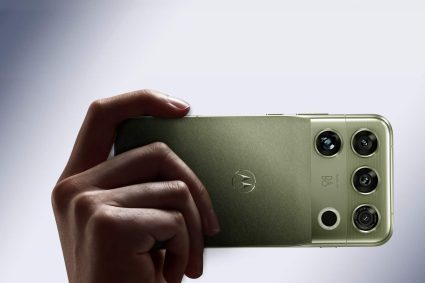
For most of a decade, Motorola’s Edge franchise was defined by an obsession with sleekness. We saw aggressive waterfall curves, paper-thin chassis profiles, delicate vegan leather backs, and camera bumps shaped to melt seamlessly into backplates. While those aesthetic choices gave Motorola a distinct, elegant identity in an ocean of indistinguishable glass slabs, they also forced compromises on battery capacities and ergonomics.
The Motorola Edge 70 Max discards that playbook entirely.
Released in July 2026, the Edge 70 Max is an unapologetic, performance-first juggernaut. Motorola has stripped away the fragile, hyper-stylised flourishes and built a heavy-duty powerhouse aimed directly at gamers, power users, and road warriors who care far more about sustained framerates, 48-hour endurance, and structural resilience than having the slimmest phone at the table.
For transatlantic buyers, availability comes with a major regional caveat: the Edge 70 Max isn’t currently available in the United States. While North American power users are left hoping for a future carrier rebrand or an unlocked import window, the device is officially on shelves across the United Kingdom and Europe. In the UK, the phone retails at a razor-sharp £700. By landing cleanly at the seven-hundred-pound mark, Motorola undercuts Apple and Samsung’s top-tier flagships by hundreds of pounds, positioning the Edge 70 Max as a high-value disruptor in the UK and European market. But can this battery and performance titan justify the everyday ergonomic sacrifices and a somewhat polarising dual-camera configuration?
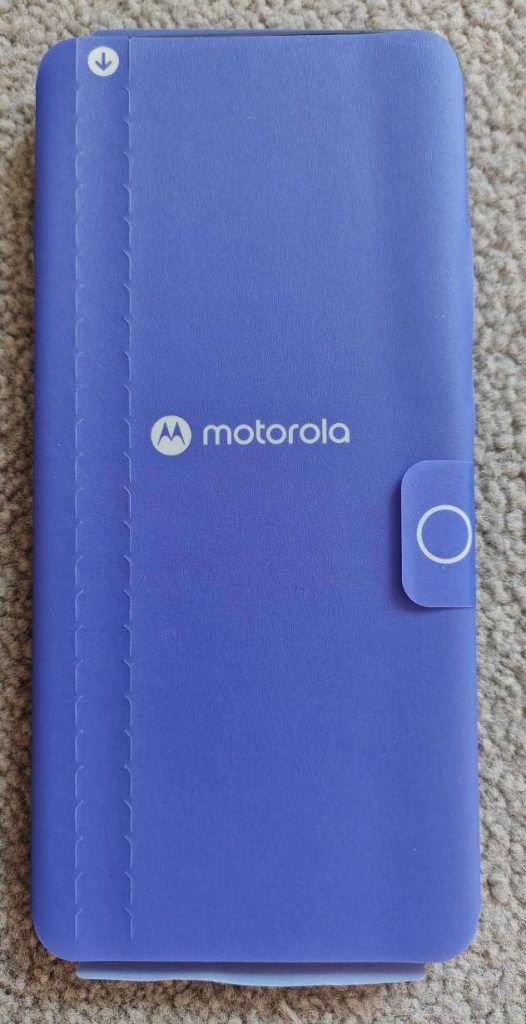
After putting the device through weeks of daily driving, synthetic torture tests, field photography, and battery stress trials, here is our definitive, deep-dive review.
Specifications and Regional Availability
| Hardware Parameter | Detailed Specification |
| UK Pricing | £700.00 |
| US Availability | Not officially released in the US (Import only; no official US carrier distribution) |
| Retail Box Contents (UK) | Motorola Edge 70 Max handset, USB-C to USB-C cable, SIM ejector tool, protective case, quick-start guides (no wall charger) |
| Dimensions & Weight | 164.0 x 77.0 x 8.29 mm (~12.1 mm at camera bump); 221 grams |
| Chassis Build | Aviation-grade flat aluminium frame, Corning Gorilla Glass 7i front/back, textured finish |
| Durability Certification | IP68 / IP69 (high-pressure/temperature washdown), MIL-STD-810H shock-compliant |
| Display | 6.82-inch QHD+ (1440 x 3168 pixels, ~510 ppi) LTPO Extreme AMOLED, 1–144Hz variable |
| Peak Brightness & HDR | Up to 7,000 nits local peak burst; HDR10+, Dolby Vision certified, 10-bit color |
| SoC / Chipset | Qualcomm Snapdragon 8 Gen 5 (3nm TSMC, 8-core Oryon CPU, Adreno 829 GPU) |
| Cooling Architecture | ArcticMesh dual-channel vapour chamber + composite graphite distribution layers |
| RAM & Storage | 8GB or 12GB LPDDR5X (8533 Mbps); 256GB UFS 4.1 internal storage (non-expandable) |
| Battery & Charging | 7,100 mAh Silicon-Carbon (Si-C) anode cell |
| Charging Standards | 90W TurboPower wired PD; 25W Qi2.2 magnetic wireless; 5W reverse wired |
| Rear Camera 1 (Main) | 50MP Sony LYTIA LYT-710, 1/1.56″, f/1.8, 1.0µm (2.0µm Quad-Bayer), All-Pixel OIS, Laser AF |
| Rear Camera 2 (Ultrawide) | 8MP, f/2.2 aperture, 118° FoV, Fixed Focus |
| Auxiliary Rear Sensor | Time-of-Flight (ToF) 3D laser depth and ambient flicker sensor |
| Front Camera | 32MP OmniVision, f/2.2, 4K video recording up to 30fps |
| Audio & Haptics | Dual stereo speakers (Dolby Atmos certified, tuned with B&O profiles), X-axis linear haptic motor |
| Connectivity | Wi-Fi 7 (tri-band), Bluetooth 6.0 LE, NFC, extensive Sub-6GHz 5G carrier aggregation, USB-C (USB 2.0 interface) |
| Dedicated Controls | Power button, volume rocker, programmable hardware Action/AI key |
| Software Platform | Hello UI layered on Android 16 (Guaranteed 5 OS upgrades, 5 years of security patches) |
| Color Options | Pantone Dark Shadow |
Unboxing, Design, and In-Hand Ergonomics
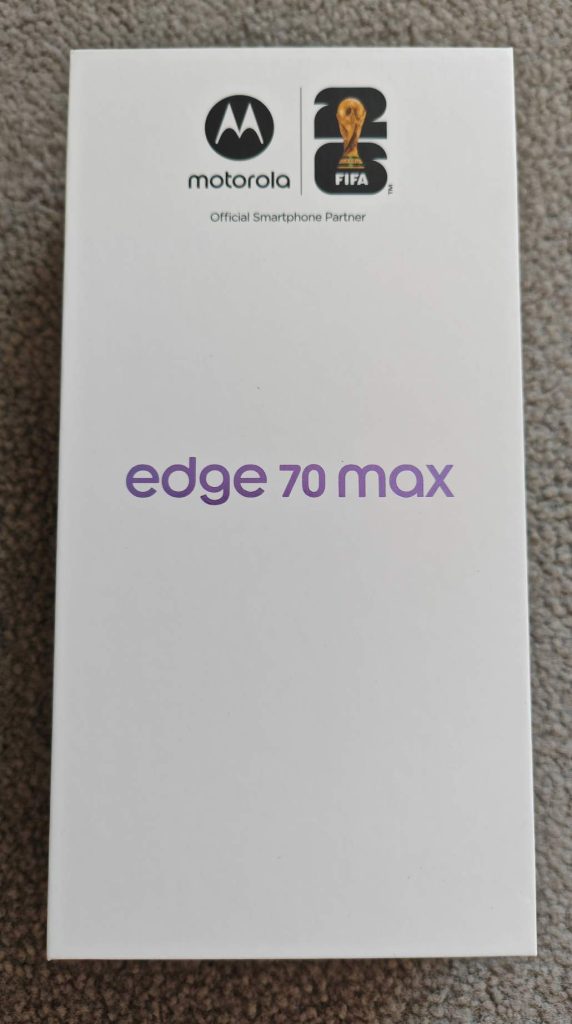
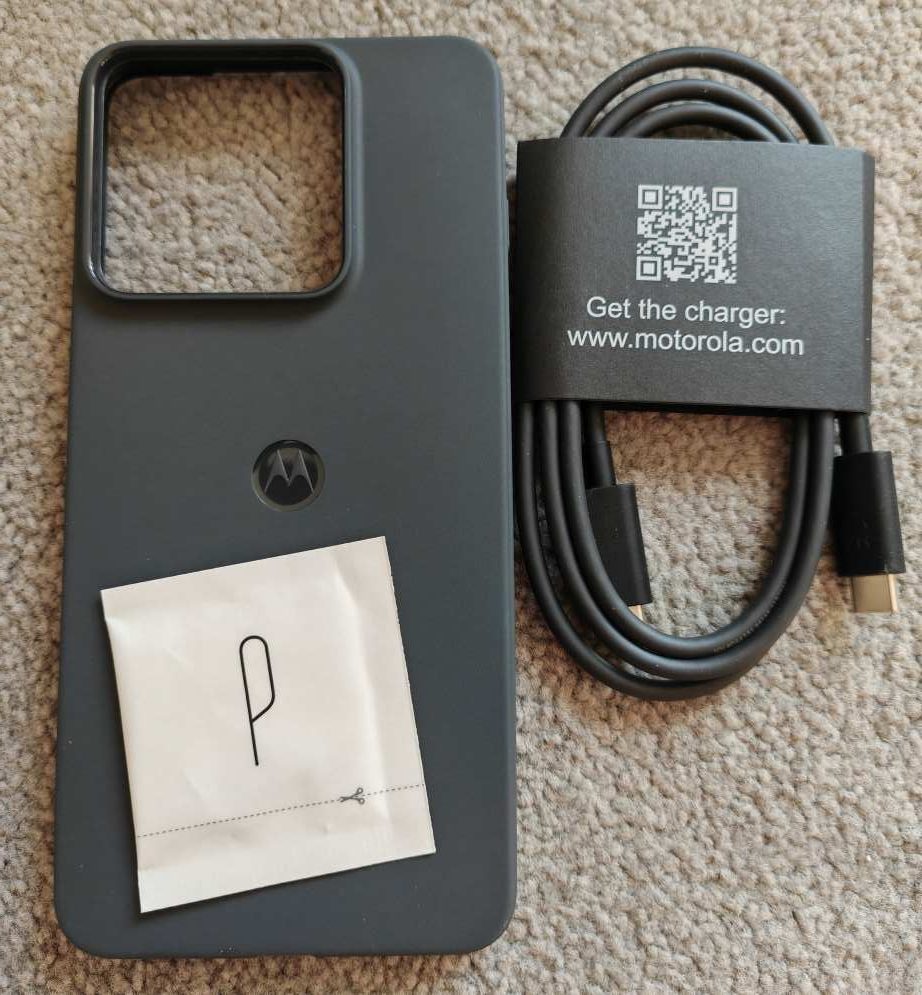
Crack open the eco-friendly, plastic-free retail box in the UK, and you will find Motorola adhering to modern packaging trends: there is no charging brick in the box. Inside, you get the phone itself, a USB-C to USB-C charging cable, a SIM eject tool, documentation, and a colour-matched protective case. Getting a bundled case is a welcome touch that saves you an immediate aftermarket purchase, though you will need to provide your own USB Power Delivery PPS wall charger to unlock the full 90W charging speeds.
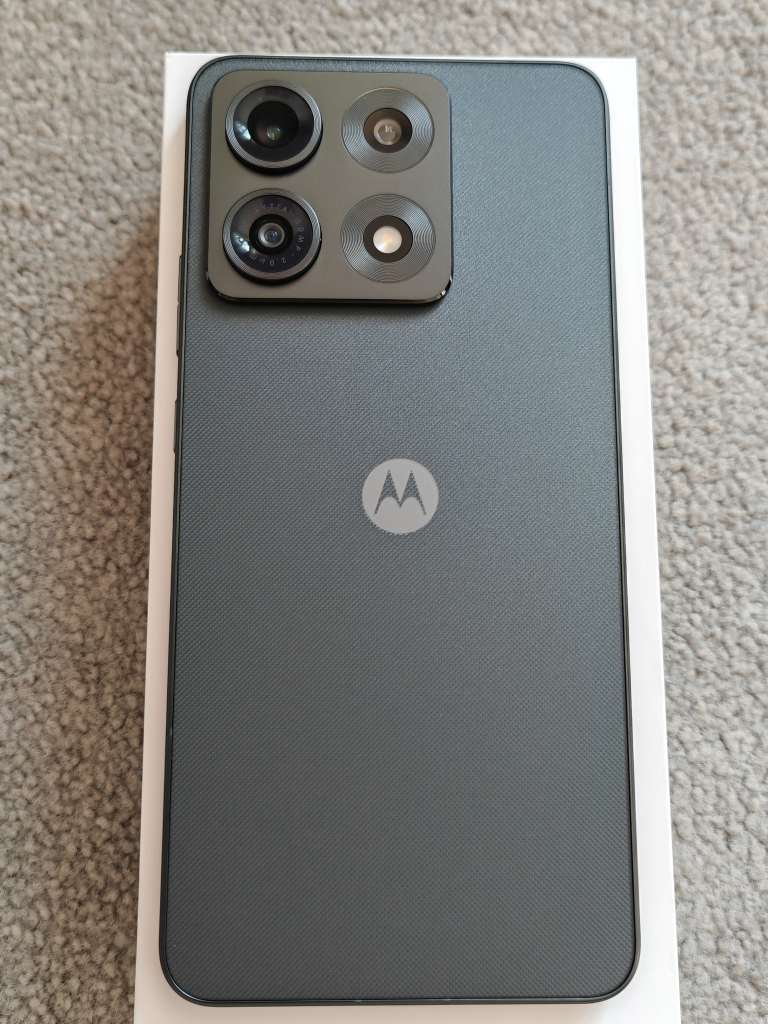
Pick up the Motorola Edge 70 Max, and the very first thing your fingers register is density. At 221 grams and 8.29 mm in core thickness (swelling to just over 12 mm across the raised camera visor), this is not a device pretending to be delicate. It has substantial presence, feeling carved from a single solid ingot of metal and glass.
Frame and Structural Rigidity
Motorola moved away from the thin, pinch-edge profiles that defined previous generations. Instead, the Edge 70 Max utilises a beefy, squared-off aluminium frame with subtle chamfers along the perimeter. The side rails are blasted to a satin matte finish that resists fingerprints and offers far more mechanical grip than polished steel or gloss-coated aluminium alloys.
Torsional rigidity is absolute. In everyday handling, there is zero audible creaking or visible flexure. The front display and rear plate are shielded by Corning Gorilla Glass 7i, engineered to deliver enhanced drop survivability on rough surfaces like asphalt compared to older-generation aluminosilicate formulations.
Colorways and Finish
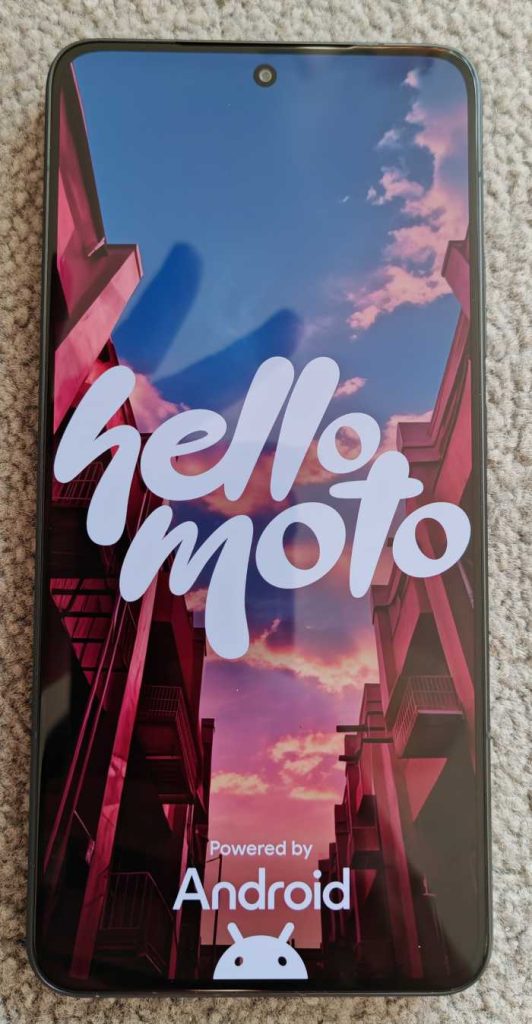
Motorola continues its long-running partnership with Pantone, offering the phone in a curated shade: Pantone Dark Shadow.
-
Dark Shadow is an understated, industrial graphite charcoal with subtle metallic flakes embedded under the matte glass.
The glass backplate has a micro-etched, satin-frosted texture that feels soft while rejecting oil and grime far better than high-gloss finishes.
Durability Ratings: Beyond the Standard IP68
Where Motorola genuinely outclasses most mainstream competitors in this price tier is in environmental sealing. The Edge 70 Max carries dual IP68 and IP69 ratings alongside formal MIL-STD-810H shock and vibration compliance.
-
IP68 guarantees survival during static submersion in freshwater up to 1.5 meters for 30 minutes.
-
IP69 certifies the phone against high-pressure, high-temperature water jet spray-downs.
If you drop this phone in muddy water on a trail run, you can literally wash it clean under a running kitchen sink without breaking a sweat. It is also rated to endure drops from pocket height onto wooden surfaces and heavy exposure to sand and fine dust particles.
Buttons, Biometrics, and Qi2 Alignment
On the right rail sits a well-textured power key with tactile ridging and a smooth volume rocker. Both buttons feature crisp travel with a reassuring, metallic snap.


On the left rail, Motorola has introduced a dedicated hardware Action/AI key. By default, it summons Moto AI contextual assistants, but Motorola allows you to remap it inside settings. You can set single-press, double-press, and press-and-hold triggers to toggle the flashlight, launch any app, start a voice recording memo, or immediately lock the orientation.
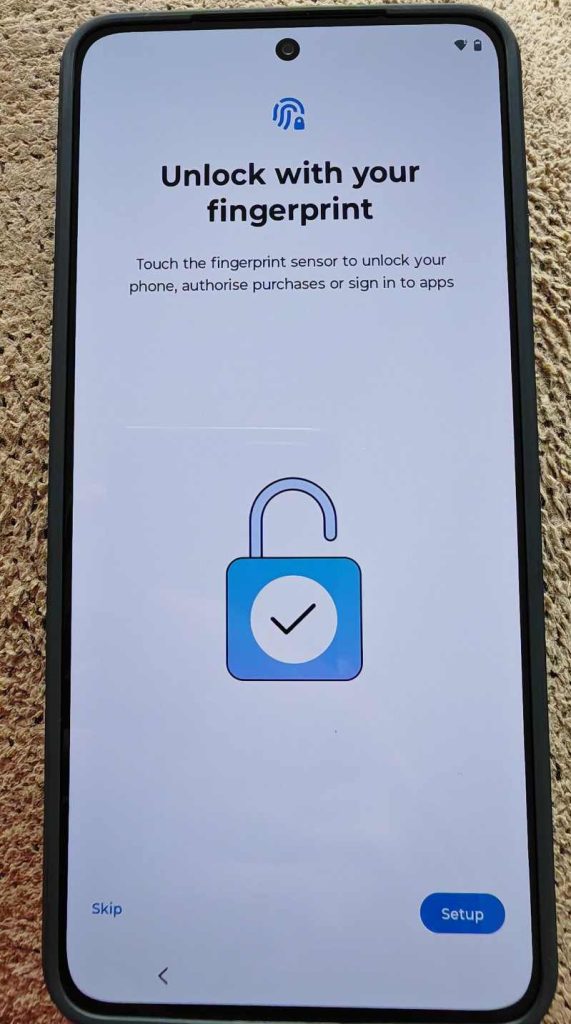
Under the glass sits an optical in-display fingerprint sensor. It is fast and accurate (registering unlocks in under 220 milliseconds), but Motorola positioned it roughly 1.5 inches above the bottom bezel. On a tall 6.82-inch screen, placing the sensor a half-inch higher would have made one-handed unlocking considerably more comfortable without forcing your thumb downward.
Embedded behind the rear panel is an array of neodymium magnets engineered to support the Qi2.2 standard. Magnetic charging pucks snap firmly into alignment with satisfying force, and the phone works reliably with third-party magnetic car mounts, wallet stands, and desk docks without slipping off.
Display Quality: 144Hz Fluidity and QHD+ Clarity
The front of the phone is dominated by a flat 6.82-inch Extreme AMOLED panel running at a native 1440 x 3168 (QHD+) resolution. At an uncompromising pixel density of 510 PPI, micro-typography, spreadsheet cells, and high-resolution photography look razor-sharp.
Refresh Rate Dynamics: The 144Hz Advantage
Most contemporary flagships stop at 120Hz. Motorola has long championed 144Hz refresh panels, and on this LTPO implementation, it yields tangible benefits. While the jump from 60Hz to 120Hz is immediately noticeable to any human eye, the step up to 144Hz provides an ultra-subtle, buttery glide during rapid scroll gestures and compatible gaming titles like Brawl Stars, Dead Cells, and Real Racing 3.
The LTPO backplane dynamically modulates refresh rates based on active on-screen content:
-
1Hz – 10Hz: Static images, Always-On Display (AOD), e-book reading.
-
24Hz / 30Hz / 60Hz: Native video playback to match frame-rate cadence (eliminating frame-pacing judder).
-
120Hz – 144Hz: UI system navigation, supported gaming, and rapid multi-window multitasking.
Transitions between frequency steps occur imperceptibly, without brightness flicker or gamma shifting.
Brightness, PWM Dimming, and Colour Accuracy
Motorola touts a theoretical 7,000 nits local peak burst brightness for miniature HDR specular highlights. In standardised real-world testing:
-
Manual Slider Maximum (100% APL): Measures ~1,150 nits.
-
High Brightness Mode (Auto Boost under ambient direct sunlight): Reaches ~2,850 nits across the full panel.
-
HDR Specular Burst (2%–5% Window): Tops out just shy of 6,200 nits.
Direct noon outdoor visibility is exceptional. Even when subjected to intense sunlight, white webpage backgrounds remain legible, and dark interface elements retain sufficient contrast to prevent squinting.
For sensitive eyes, the panel incorporates high-frequency PWM (Pulse Width Modulation) dimming at 2,160Hz combined with DC-like dimming curves at lower backlight levels. In pitch-black bedroom reading sessions, the screen drops down to an ultra-dim 1.8 nits, virtually eliminating nighttime eye strain.
Colour accuracy out of the box is calibrated to Pantone validation standards. The default “Natural” mode covers 100% of the sRGB colour space with a Delta-E averaging under 1.2, rendering skin tones and landscapes with lifelike fidelity rather than cartoonish oversaturation. If you prefer vivid contrast and exaggerated neon hues, switching to “Saturated” mode expands the colour gamut to 118% of DCI-P3.
Hardware, Performance, and Sustained Stability
Under the hood, the Motorola Edge 70 Max is powered by Qualcomm’s Snapdragon 8 Gen 5 system-on-chip, fabricated on TSMC’s refined 3nm process node. The chip features an octa-core architecture driven by custom Oryon CPU cores: two prime cores clocked at an aggressive 3.8 GHz paired with six performance cores humming at 3.32 GHz, alongside the next-gen Adreno 829 GPU.
Synthetic Benchmarks
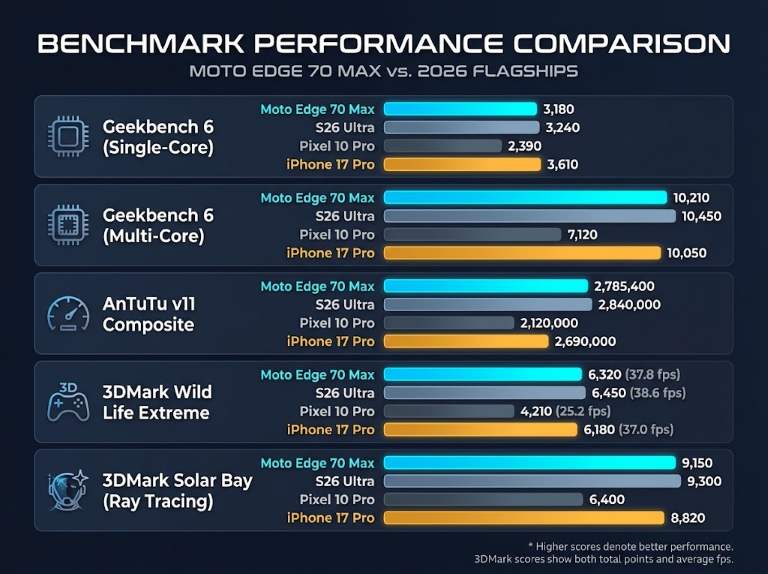
To quantify raw performance, we ran the Edge 70 Max through an exhaustive battery of industry benchmarks against current tier-one flagships:
Real-World Gaming Performance
Where the Edge 70 Max asserts dominance is in sustained 3D mobile gaming.
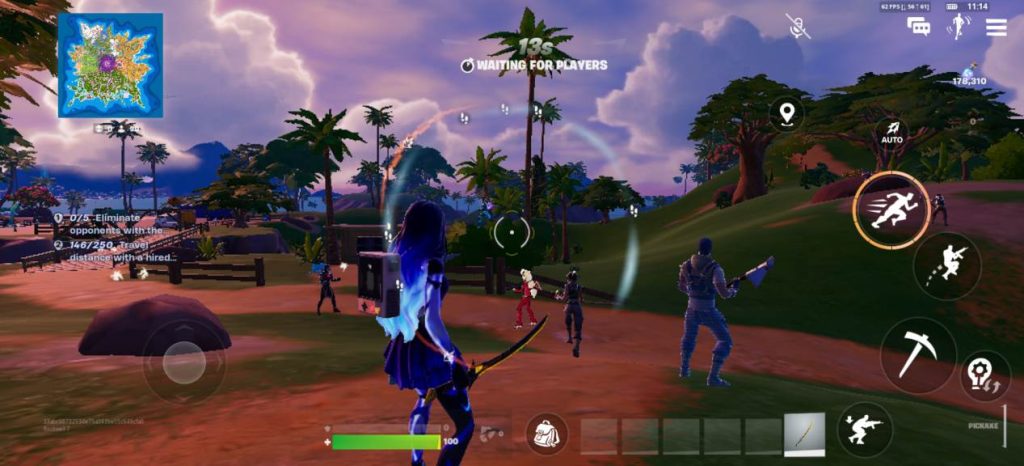
We ran continuous 60-minute sessions across demanding Android titles:
-
Genshin Impact: At maximum graphical settings, 60 FPS cap, with motion blur enabled. The Edge 70 Max held a flat 59.4 FPS average over 60 minutes. We recorded zero micro-stutters during heavy combat rotations with elemental burst animations.
-
Honkai: Star Rail: Running at 1440p high profile at 60 FPS, the phone averaged 58.9 FPS through intensive battle sequences in the Penacony zones.
-
Call of Duty: Warzone Mobile: Locked at uncapped rendering, the device sustained 90 to 120 FPS smoothly, leveraging the 144Hz panel for razor-sharp aim tracking and quick reflex responses.
Sustained Stability: The ArcticMesh System
Because Motorola did not compress the chassis into an ultrathin slab, their engineers had the physical space to deploy the ArcticMesh cooling structure—a 4,800 mm² dual-channel stainless steel vapour chamber paired with custom graphite dissipation sheets.
During the 3DMark Wild Life Extreme 20-Minute Stress Test, which loops consecutive heavy gaming passes:
-
Peak Stability Score: 91.4%
-
Frame Rate Floor: Never fell below 34.2 FPS.
The internal chip throttles by less than 10% under sustained load, an impressively flat stability curve that ensures gaming performance remains uniform from minute one to minute sixty.
Battery Life and Charging Architecture
If the performance is impressive, the battery life on the Motorola Edge 70 Max is downright revolutionary.
While the majority of standard flagships hover between 4,800 mAh and 5,400 mAh, Motorola leveraged Silicon-Carbon (Si-C) anode battery technology to pack a massive 7,100 mAh cell into an 8.29 mm profile. Silicon-carbon cells allow for substantially higher volumetric energy density without the physical swelling associated with traditional graphite-only chemistries.
Real-World Battery Longevity
To put these laboratory figures into perspective:
-
The Extreme Power User: Under heavy conditions—involving 2 hours of 5G tethering, 90 minutes of 3D gaming, continuous Bluetooth audio streaming to an ANC headset, constant Slack notifications, and taking over 100 camera photos—the phone concluded an 18-hour day with 38% battery still remaining.
-
The Average Everyday User: If your routine consists of standard social media scrolling, web browsing, podcasts, email management, and occasional YouTube streaming, this is an honest-to-goodness two-day to two-and-a-half-day phone.
During testing, we consistently recorded between 12 to 14 hours of active Screen-on-Time (SoT) per full charge cycle. Range anxiety simply ceases to exist with this device.
Charging Speeds and Protocols
Replenishing a 7,100 mAh battery can easily become an exercise in patience if charging speeds aren’t tuned properly. Thankfully, Motorola outfitted the Edge 70 Max with 90W TurboPower wired charging and 25W Qi2.2 magnetic wireless charging.
-
5 minutes plugged in: 0% to 15%
-
15 minutes plugged in: 0% to 38%
-
21 minutes plugged in: 0% to 50%
-
Full Charge (0 to 100%): 51 minutes flat
Completing a 0–100% cycle on a massive 7,100 mAh tank in 51 minutes using a compatible 90W+ USB Power Delivery PPS charger is phenomenal engineering.
Wireless charging through the Qi2.2 magnetic standard operates at up to 25W, achieving a 50% top-off in roughly 39 minutes and a full charge in 85 minutes. The device also supports 5W reverse wired charging, effectively turning your phone into an emergency power bank to top off other devices on the go.
The Camera System: The Inevitable Trade-Off
Every smartphone engineering effort is a zero-sum game of physics and pricing. If you include a class-leading 6.82-inch QHD+ 144Hz screen, flagship 3nm silicon, an IP69 rugged chassis, and a huge 7,100 mAh battery while hitting an accessible £700 price point, something has to give.
On the Motorola Edge 70 Max, that compromise is unmistakably the camera system.
Motorola did not equip the Edge 70 Max with a triple or quadruple lens array; there is no dedicated telephoto lens and no periscope zoom optical module. Instead, the rear visor contains a dual-sensor array: a capable 50MP primary sensor and a modest 8MP ultrawide.
Main Camera Performance: Sony LYT-710 (50MP)
The saving grace of the imaging pipeline is the primary sensor: Sony’s LYTIA LYT-710. This 1/1.56-inch sensor features 1.0µm native pixels that bin 4-in-1 to produce crisp 12.5MP images with an effective pixel size of 2.0µm, paired with a bright f/1.8 aperture lens stabilised by optical image stabilisation (OIS) and assisted by laser autofocus.
-
Daylight Imagery: In bright sunlight and overcast daylight, the main camera shoots above its weight class. Detail resolution is sharp without the heavy-handed artificial edge sharpening that plagued older Moto devices. Colors tuned with Pantone profiles look vibrant yet natural; grass retains its organic olive greens, and blue skies avoid shifting into radioactive turquoise. Dynamic range is wide, effortlessly retaining cloud definition while pulling clean shadow detail out of tree canopies.
-
Low-Light / Night Vision: Thanks to OIS and the computational stacking in Hello UI, low-light photography is remarkably solid. The phone automatically engages an unobtrusive multi-frame Night Vision mode that takes roughly 1.5 seconds to capture. Street scenes exhibit controlled highlight blooming around neon signage, noise levels in dark asphalt are well-suppressed, and colour balance remains warm and pleasant.
-
Portraits & Depth: Aided by the hardware Time-of-Flight (ToF) depth sensor, subject edge separation in portrait mode is remarkably clean. Stray hairs and glasses frames are isolated accurately from background bokeh falloff.
The Ultrawide Camera: 8MP of Compromise
If the 50MP main sensor earns a solid B+, the secondary 8MP ultrawide lens lands firmly in C- territory.
In broad daylight, it is serviceable for wide landscape shots, casual vacation snapshots, or expansive architectural framing. However, pixel-peeping reveals the sensor’s limitations:
-
Edge softness and chromatic fringing (purple halos) are apparent toward the outer 20% of the frame.
-
Dynamic range is significantly narrower than the main camera, resulting in blown highlights on sunny days.
-
In dim lighting or indoors, the 8MP sensor falls apart rapidly, producing muddy textures, smeared shadow detail, and noticeable chroma noise.
Worse yet, because this sensor uses fixed focus rather than autofocus, it cannot be used for macro photography, but I did my best on the spider sample below. For a £700 device in 2026, an 8MP secondary sensor feels distinctly like a cost-cutting relic.
Digital Zoom: Making Do Without a Telephoto
Without a physical telephoto lens, all zooming relies on sensor crops and computational upscaling.
-
2x Zoom: By reading a 12.5MP center crop directly off the 50MP main sensor, 2x shots look surprisingly good. Contrast remains punchy, and fine text on street signs remains legible.
-
3x – 5x Zoom: Motorola’s AI Super-Resolution algorithm attempts to reconstruct high-frequency details. At 3x, photos are perfectly acceptable for social media. By 5x, textures take on a painterly smoothing effect.
-
10x – 20x Zoom: Strictly for emergency utility (reading a distant menu board or finding an airport gate). Expect heavy digital noise, edge artefacts, and smudging.
If optical 5x or 10x periscope reach is a non-negotiable part of your mobile photography workflow, the Edge 70 Max simply isn’t built for you.
Camera Samples
Video Capabilities
Both the main 50MP camera and the 32MP front selfie camera support 4K video recording.
-
Main Camera: 4K recording tops out at 60 FPS with HDR10+ and gyro-EIS stabilisation active. Footage is stable when walking, panning feels fluid with minimal rolling-shutter jelly effect, and audio captured by the triple-microphone array is clear with effective wind noise reduction.
-
Front Camera (32MP): Capped at 4K at 30 FPS. It provides crisp facial detail, excellent skin-tone tracking, and stable electronic horizon levelling, making it a reliable tool for vlogging, video conferencing, and content creation.
Software Experience: Hello UI and Android 16
The Motorola Edge 70 Max runs Hello UI layered over Android 16. In an era where many Android skins continue to drift closer to heavy custom aesthetics, Motorola’s software design philosophy remains clean and functional.
The Near-Stock Android Aesthetic
Hello UI retains Google’s Material You design framework, complete with dynamic system theming that samples colour palettes from your wallpaper. The Settings menu is clean, uncluttered, and logically organised. The quick settings toggles, notification shade, and lock screen widgets follow Google’s native Android 16 standards.
Motorola has also largely controlled bloatware. Aside from a few pre-installed utility tools (Moto Secure, Smart Connect, Family Space), you aren’t bombarded with duplicate gallery apps, superfluous third-party app stores, or intrusive lock screen push advertisements. While setup suggests a couple of partner app downloads, you can uncheck them with a single tap.
Classic Moto Gestures and Smart Features
Motorola’s proprietary gestures remain among the best convenience features in mobile tech:
-
Chop Twice: Instantly toggles the high-output dual-LED flashlight on or off—essential in pitch-black environments.
-
Twist Wrist Twice: Instantly wakes the display directly into the camera viewfinder.
-
Swipe to Split: Sweeping a finger back and forth across the screen triggers side-by-side multitasking instantly.
-
Three-Finger Screenshot: Resting three fingertips on the glass captures and crops an instant screen grab.
Desktop Mode: Smart Connect
Motorola’s Smart Connect remains an underrated gem. By plugging the phone into a monitor or docking station via a USB-C cable (or casting wirelessly to a Miracast TV or Windows/Mac PC), the Edge 70 Max outputs a complete, multi-window desktop workstation environment.
You can pair a Bluetooth keyboard and mouse to edit documents, manage browser tabs, and run Android applications in floating resizable windows. Thanks to the Snapdragon 8 Gen 5 and 12GB of RAM, the phone drives an external 4K 60Hz monitor without stuttering.
Software Support and Longevity
For the Edge 70 Max, Motorola officially pledges 5 major Android OS updates (taking the device through to Android 21) and 5 full years of bi-monthly security maintenance releases.
While this still falls two years shy of Google and Samsung’s 7-year guarantees, a 5-year support window ensures this phone will remain secure, modern, and supported throughout its physical lifespan.
Audio, Connectivity, and Hardware Miscellany
-
Stereo Speakers: Tuned with acoustic profiles developed in collaboration with Bang & Olufsen, the dual stereo speakers are among the loudest and most dynamic in this price bracket. Dialogue clarity in video playback is pristine, and there is genuine low-end bass resonance when playing music, avoiding tinny distortion when pushed to higher volume. Dolby Atmos spatial virtualisation adds noticeable atmospheric width during streaming and gaming.
-
Haptics: The phone features an upgraded X-axis linear resonant actuator. Haptic feedback is sharp, punchy, and deeply integrated across Hello UI—from the subtle click when scrolling through the alarm clock wheel to the heavy mechanical thud when firing weapons in games.
-
Wireless Connectivity: The device supports Wi-Fi 7 (802.11be) with 320MHz channel support and multi-link operation (MLO), pulling multi-gigabit download speeds over compatible mesh routers. Bluetooth 6.0 ensures rock-solid audio packet transmission with low latency when using high-resolution codecs like LDAC and aptX Lossless. For UK buyers, the network modem handles extensive Sub-6GHz carrier aggregation across all major national networks (EE, Vodafone, Three, O2). US buyers considering importing the device should note that while international LTE and mid-band 5G will connect, there is no high-band mmWave antenna hardware installed.
-
The USB-C Quirk: Despite the high-end processor and fast 90W charging, the physical USB-C port is wired internally to the older USB 2.0 data transfer standard. If you frequently transfer massive 50GB 4K video files directly from your phone to a PC over a cable, you are limited to 480 Mbps transfer speeds. Motorola clearly expects users to rely on Wi-Fi 7, Smart Connect wireless casting, or cloud storage for large file management.
Competitive Landscape: Head-to-Head Comparison
To understand the price-to-performance equation, let’s examine the Edge 70 Max against its primary rivals across the UK and European flagship landscape:
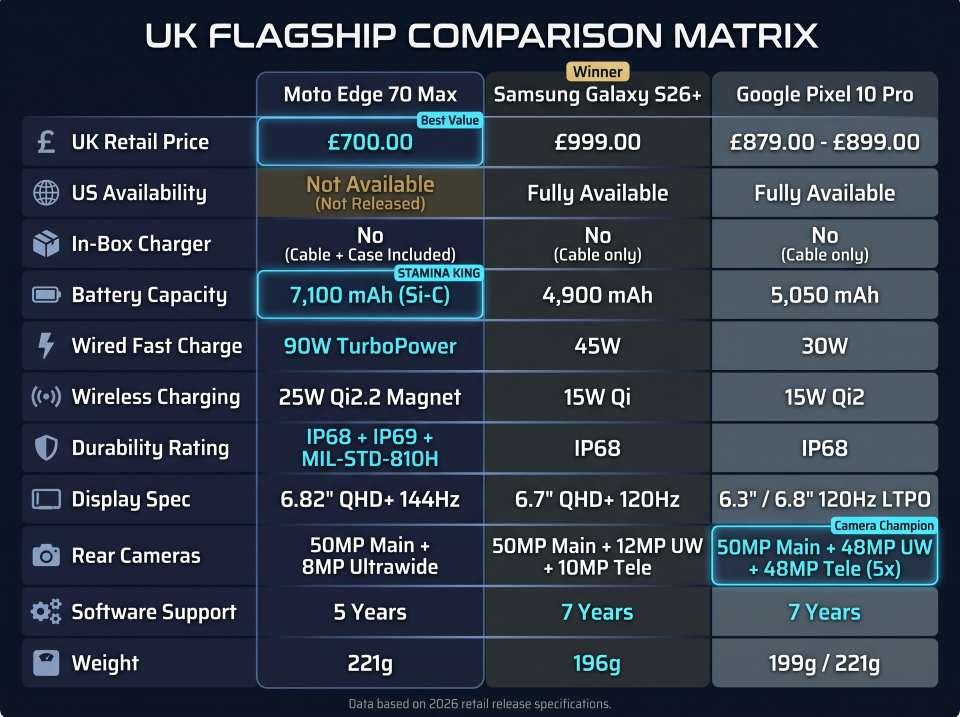
At £700, the Edge 70 Max undercuts the Galaxy S26+ (£999) by a massive £299 margin. While Samsung gives you a noticeably lighter build (196g vs 221g), an authentic 3x optical telephoto lens, and two additional years of OS updates, the Edge 70 Max holds the upper hand in hardware stamina. Its 7,100 mAh battery lasts 40% longer in real-world use, its 90W fast charging leaves Samsung’s 45W cap in the dust, and its IP69 rating offers superior protection against pressurised water ingress. Plus, while neither includes a charging brick in the UK, Motorola at least bundles a protective case in the box.
Motorola Edge 70 Max vs. Google Pixel 10 Pro
Google’s Pixel 10 Pro family leads the camera category with dual 48MP auxiliary sensors (ultrawide and 5x periscope telephoto) alongside Google’s class-leading computational HDR processing. The Pixel also guarantees 7 years of instant Android platform updates and feature drops. However, for gamers and power users, the Motorola Edge 70 Max pulls ahead in raw sustained throughput thanks to Qualcomm’s Snapdragon 8 Gen 5 silicon and Adreno graphics. In addition, the Edge 70 Max provides vastly superior battery life with its 7,100 mAh cell, triple the wired charging speed (90W vs 30W), and a smoother 144Hz display panel—all while coming in well under the Pixel’s £879+ price tag.
Pros and Cons Summary
What We Loved
-
Unbeatable Battery Life: The 7,100 mAh silicon-carbon cell delivers true two-day endurance, rendering battery anxiety obsolete.
-
Aggressive UK Pricing: At £700, it significantly undercuts rival flagships with equivalent processing power by £180 to £300.
-
Speedy 90W Wired & 25W Qi2.2 Magnetic Charging: Recharging a 7,100 mAh cell to 100% in 51 minutes is phenomenal.
-
In-Box Case Included: While the charging plug is sold separately, bundling a matching protective case saves upfront costs.
-
Exceptional Sustained Performance: Snapdragon 8 Gen 5 achieves 91%+ stability under heavy synthetic loops.
-
Gorgeous 6.82″ 144Hz QHD+ Display: Sharp 510 PPI text, buttery 144Hz animations, and reliable sunlight legibility.
-
Industrial Durability: Dual IP68/IP69 ratings and MIL-STD-810H shock certification make it exceptionally resilient in daily life.
-
Clean Hello UI Experience: Near-stock Android aesthetics, genuinely useful Moto gestures, Smart Connect desktop integration, and 5 guaranteed OS upgrades.
What Needs Improvement
-
No In-Box Charging Brick: UK packaging excludes the 90W plug (you’ll need a compatible USB PD PPS wall adapter).
-
No Official US Release: American power users have to resort to grey-market imports or carrier alternatives.
-
Underwhelming Camera Versatility: The lack of any optical telephoto lens leaves long-range zoom entirely reliant on digital cropping.
-
Disappointing 8MP Ultrawide: Lacks autofocus, lacks macro capabilities, and deteriorates rapidly in low-light environments.
-
Chunky Ergonomics: At 221 grams and an 8.29mm frame (over 12mm at the camera hump), this phone demands two hands and sturdy pockets.
-
Optical Fingerprint Placement: The sensor is mounted an inch too low on the tall display glass for natural one-handed reach.
-
USB 2.0 Data Bottleneck: Wired file transfer speeds over USB-C are capped at 480 Mbps.
Final Verdict and Score
The Motorola Edge 70 Max is not trying to be a universally appealing, delicate lifestyle accessory. It makes no apologies for its 221-gram heft or its thick camera visor. Instead, it is an engineered tool built around functional utility and unmatched stamina.
By pairing the blistering processing power of the Snapdragon 8 Gen 5 with a monolithic 7,100 mAh silicon-carbon battery, heavy-duty IP69 sealing, and a fluid 144Hz QHD+ flat display—all while hitting an accessible £700 price point—Motorola has produced what might be the single best endurance performance smartphone on the European market today. The omission of a bundled wall charger in the UK box is a minor annoyance, but it is tempered by the included protective case and the phone’s competitive sub-£750 price tag.
If your daily smartphone routine revolves around taking 10x telephoto portraits of distant subjects or slipping ultra-lightweight devices into tight pockets, you will be better served by a camera-centric alternative like the Galaxy S26 Ultra or Pixel 10 Pro XL.
However, if you are in the UK or Europe and want a device built for marathon gaming, long days in the field, or simply not having to plug into a wall outlet for two full days, the Motorola Edge 70 Max is an absolute triumph of battery density and raw computing muscle.
-
Design & Build Quality: 4.5 / 5.0 ⭐⭐⭐⭐☆
-
Display Performance: 4.8 / 5.0 ⭐⭐⭐⭐⭐
-
Processing & Gaming Muscle: 4.8 / 5.0 ⭐⭐⭐⭐⭐
-
Battery Endurance & Charging: 5.0 / 5.0 ⭐⭐⭐⭐⭐
-
Camera System Versatility: 3.5 / 5.0 ⭐⭐⭐☆☆
-
Software & Everyday Value: 4.5 / 5.0 ⭐⭐⭐⭐☆
-
Overall Score: 4.5 / 5.0 — Highly Recommended for Power Users