Mini-PCs have traditionally been a compromise: small footprint, modest performance, and limited headroom for demanding workloads. That balance is now shifting.
With the introduction of the ASUS Ascent QN10, the first AI mini-PC powered by the Snapdragon X2 Elite, Qualcomm Technologies and ASUS are extending the Snapdragon X Series beyond laptops and into the desktop and small form factor space.
Unveiled at Computex 2026, the QN10 signals a broader transition: high-performance computing no longer needs a large chassis, loud cooling, or excessive power draw. Instead, it can be delivered in a compact system designed for modern work environments where space, efficiency and AI capability matter just as much as raw speed.
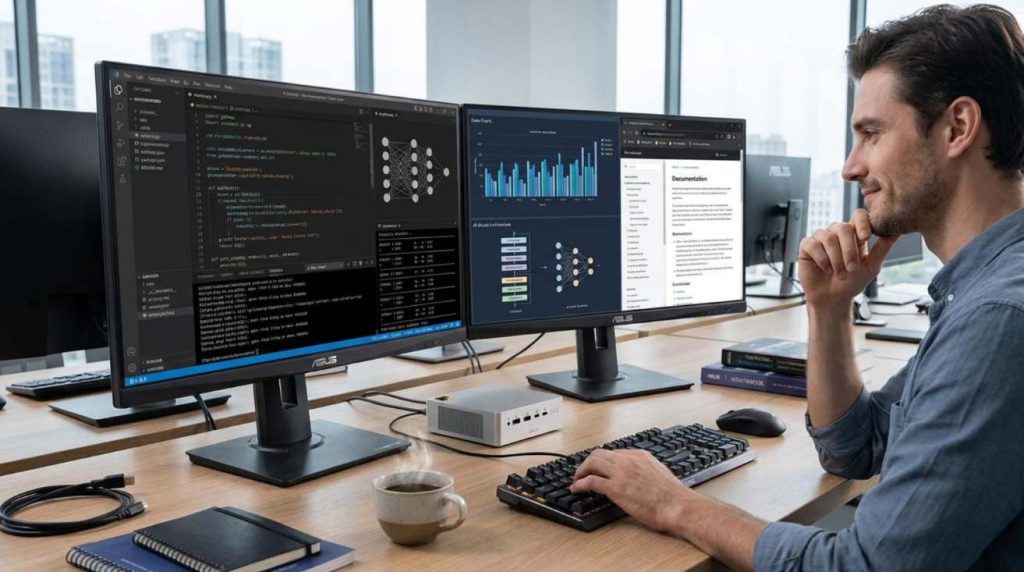
What you should know
The ASUS Ascent QN10 brings together a tightly integrated set of capabilities built around the Snapdragon X2 Elite platform:
- It is the first AI mini-PC based on the Snapdragon X2 Elite
- It delivers flagship-class performance alongside advanced on-device AI processing
- It is designed for exceptional energy efficiency across sustained workloads
- It features an 80 TOPS neural processing unit (NPU) for AI acceleration
- It includes chip-to-cloud security designed to protect data across system layers
Taken together, these elements position the QN10 as a compact desktop aimed at professionals, developers, and organisations adopting AI-first workflows.
Snapdragon X2 Elite: bringing premium performance to the desktop
At the core of the system is the Snapdragon X2 Elite platform, designed to handle demanding desktop workloads while maintaining a strong focus on efficiency and thermal stability.
Rather than relying on traditional trade-offs between performance and power consumption, the platform is engineered to sustain high levels of throughput across long working sessions. This makes it suitable for environments where users are running multiple intensive applications simultaneously, such as development tools, data pipelines, creative suites, and AI workloads.
A key differentiator is the integrated 80 TOPS NPU. This dedicated AI engine enables local execution of advanced models and agent-based workflows without requiring constant cloud dependency. In practical terms, it allows the system to handle tasks such as:
- Local AI inference and model experimentation
- Multi-step agent orchestration and automation
- Real-time productivity assistance
- Background AI processing without impacting system responsiveness
The platform is also designed with enterprise security expectations in mind. Chip-level protections extend through to the cloud layer, helping safeguard sensitive data across workloads and applications. This is particularly relevant for organisations deploying AI tools in regulated or security-conscious environments.
A compact design built for modern spaces
One of the most striking aspects of the ASUS Ascent QN10 is its physical footprint.
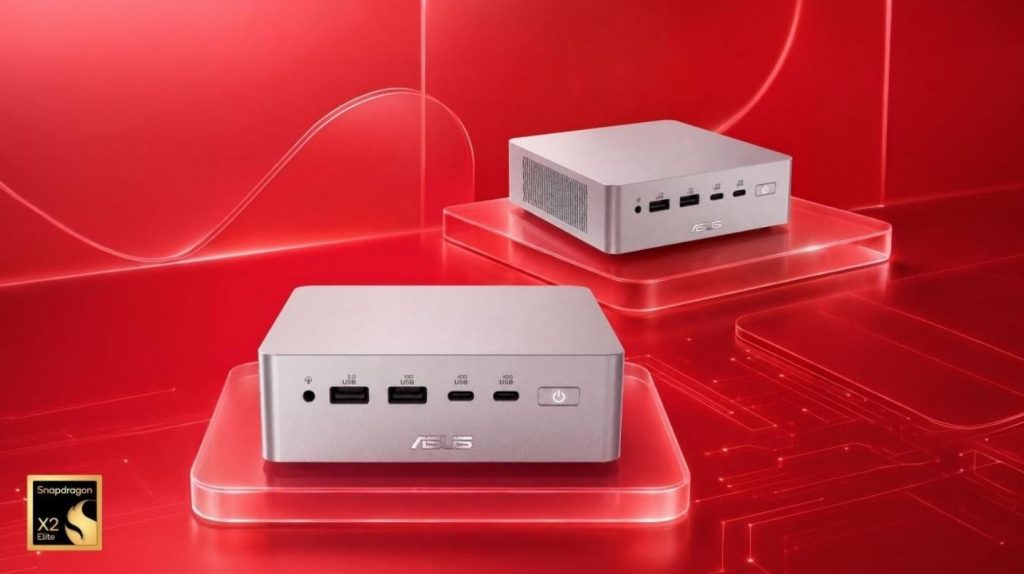
With a chassis volume of under 0.7 litres, it is significantly smaller than conventional mini-PC systems, reportedly around 86% smaller than a typical 5-litre desktop alternative. Despite this reduction in size, it retains the performance characteristics expected from a full desktop-class system built on Snapdragon X2 Elite.
This compact form factor makes it particularly suited to environments where space is limited or where clean, minimal setups are preferred. Examples include:
- Modern office desks with shared workstations
- Creative studios where multiple systems are deployed
- Home workspaces requiring quiet, unobtrusive hardware
- Retail and industrial installations with constrained mounting space
The design philosophy focuses on integrating high performance into environments rather than dominating them. The result is a system that can sit behind a monitor, under a desk, or within a rack-style deployment without compromising usability or airflow efficiency.
Who the ASUS Ascent QN10 is designed for
The combination of Snapdragon X2 Elite performance and compact hardware design means the QN10 targets a wide range of users, each with distinct requirements.
Creative professionals and power users
For content creators, designers, and multitaskers, the system provides enough headroom to handle demanding workloads such as editing, rendering, and simultaneous application use. It also supports lighter gaming and entertainment workloads, making it suitable as a dual-purpose workstation.
Developers and AI practitioners
Developers benefit from sustained performance during long coding sessions, fast build cycles, and responsive tooling environments such as Visual Studio Code.
More importantly, the integrated AI capabilities open up workflows that are increasingly central to modern development:
- Local model testing and inference
- Agent-driven automation workflows
- Experimentation with AI orchestration systems
- Integration with tools such as OpenAI Codex and other AI assistants
The platform is also positioned to support emerging agent frameworks, including tools such as Cursor and Claude Desktop, enabling more autonomous development workflows.
Small businesses and enterprise environments
For business deployments, the QN10 offers a balance of performance, manageability and low acoustic output. Its design supports quiet operation, making it suitable for open-plan offices and customer-facing environments.
Enterprise-grade security features and centralised management capabilities make it easier to deploy at scale, particularly where consistent system behaviour and strong data protection are required.
Industrial and signage use cases
In commercial and industrial contexts, the system can drive multi-display setups, including quad 4K configurations. This makes it suitable for:
- Digital signage networks
- Control room dashboards
- Real-time monitoring systems
- Interactive information displays
Its ability to operate continuously while maintaining efficiency is a key advantage in always-on environments.
Connectivity and expandability
Despite its small size, the ASUS Ascent QN10 does not compromise on connectivity.
It includes a broad selection of ports designed to support both modern peripherals and legacy equipment:
- Three USB4 ports
- Three USB 3.2 (Gen 2) ports
- One USB 2.0 port
This combination allows users to connect high-speed storage devices, multiple displays, development hardware, and external accessories without relying heavily on dongles or hubs.
For developers and power users in particular, this level of connectivity is important for building test environments, connecting debugging tools, and managing multi-device workflows.
Efficiency without compromise
One of the key themes behind Snapdragon X2 Elite is sustained performance per watt.
Rather than pushing peak performance at the expense of heat and noise, the platform is designed to maintain consistent output over extended periods. This results in:
- Lower thermal load
- Reduced fan noise
- Improved energy efficiency
- More stable long-duration workloads
For users working in shared or quiet environments, this can make a noticeable difference in day-to-day usability. It also reduces operational costs for organisations deploying multiple units at scale.
The broader shift in desktop computing
The arrival of Snapdragon X2 Elite in mini-PC form marks a broader shift in how desktop systems are being designed.
Historically, performance computing has been tied to larger systems with high power consumption. The QN10 challenges that assumption by demonstrating that advanced AI workloads and high-performance computing can now be delivered in compact, efficient devices.
This shift is driven by three converging trends:
- The rise of on-device AI processing
- Improvements in performance-per-watt efficiency
- Demand for smaller, more flexible work environments
As these trends continue, small form factor systems are likely to become increasingly capable, reducing the gap between desktops, laptops, and edge computing devices.
Looking ahead
The ASUS Ascent QN10 is an early example of what Snapdragon X Series platforms can deliver beyond traditional laptop designs.
With Snapdragon X2 Elite at its core, it demonstrates that compact systems can now support advanced AI workloads, professional development environments, and enterprise-grade computing tasks without compromise.
For Qualcomm Technologies, this marks an expansion of its platform strategy into new computing categories. For ASUS, it represents a continuation of its focus on compact, high-performance hardware design.
As AI workloads become more central to everyday computing, systems like the QN10 suggest a future where performance, efficiency, and intelligence are built into increasingly smaller devices—without sacrificing capability.
Final thoughts
The ASUS Ascent QN10 is less about redefining mini-PCs in isolation and more about redefining expectations for what a desktop can be.
By combining Snapdragon X2 Elite’s AI acceleration, strong sustained performance, and energy efficiency with a highly compact chassis, it presents a vision of desktop computing that is quieter, smaller, and more intelligent than traditional systems.
If this direction continues, the next generation of desktops may look less like fixed workstations and more like adaptable computing nodes—placed wherever performance is needed most.
More stories